
Oktoberfest Highlight: More Than 8,000 Participants Parade Through Munich
Traditional Costume and Marksmen’s Parade at Oktoberfest 2026
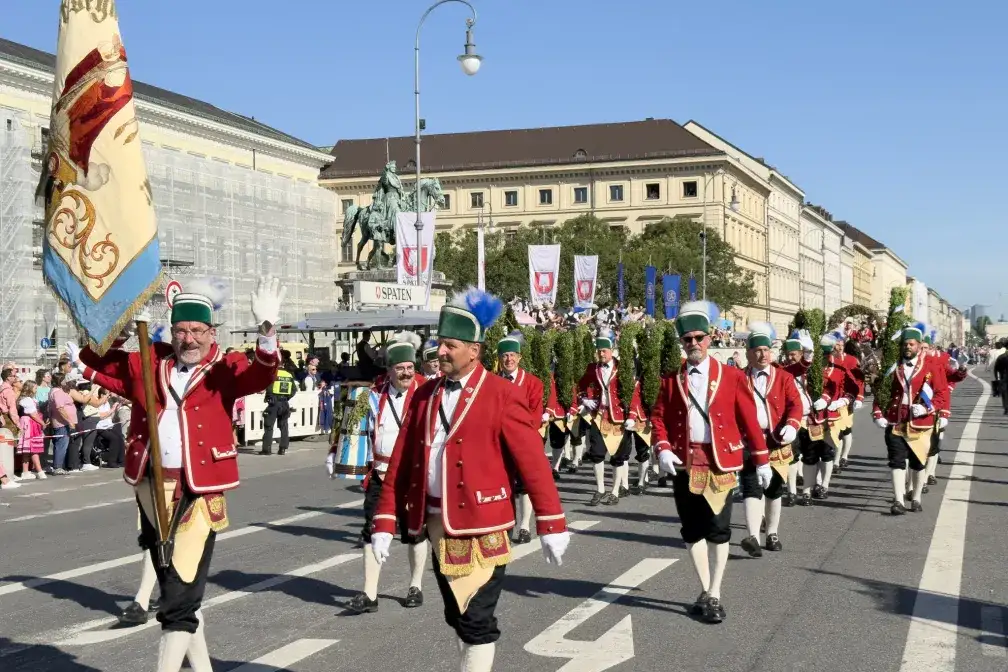
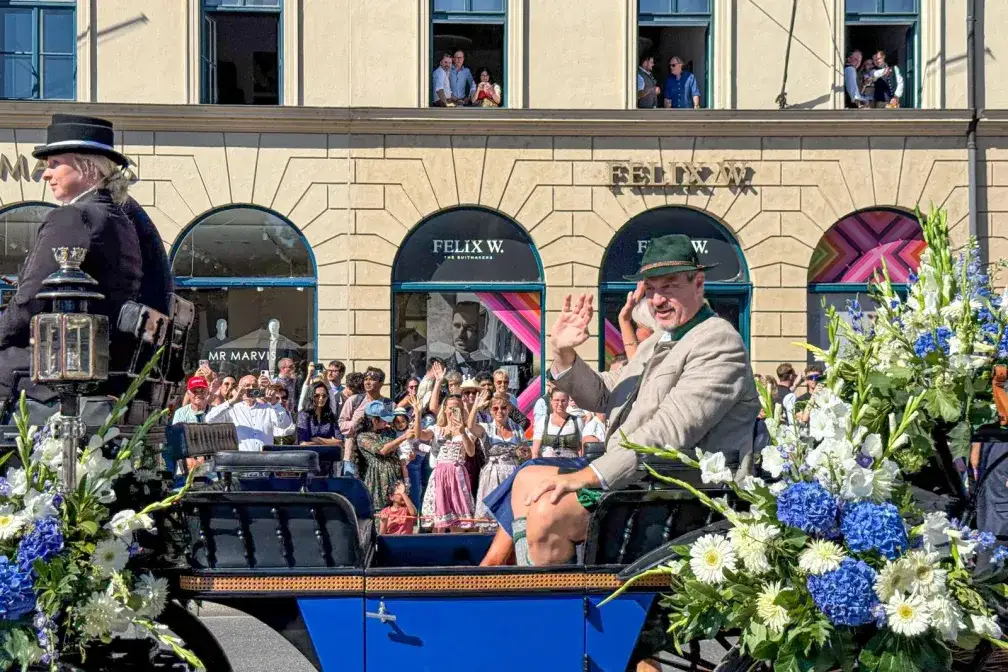
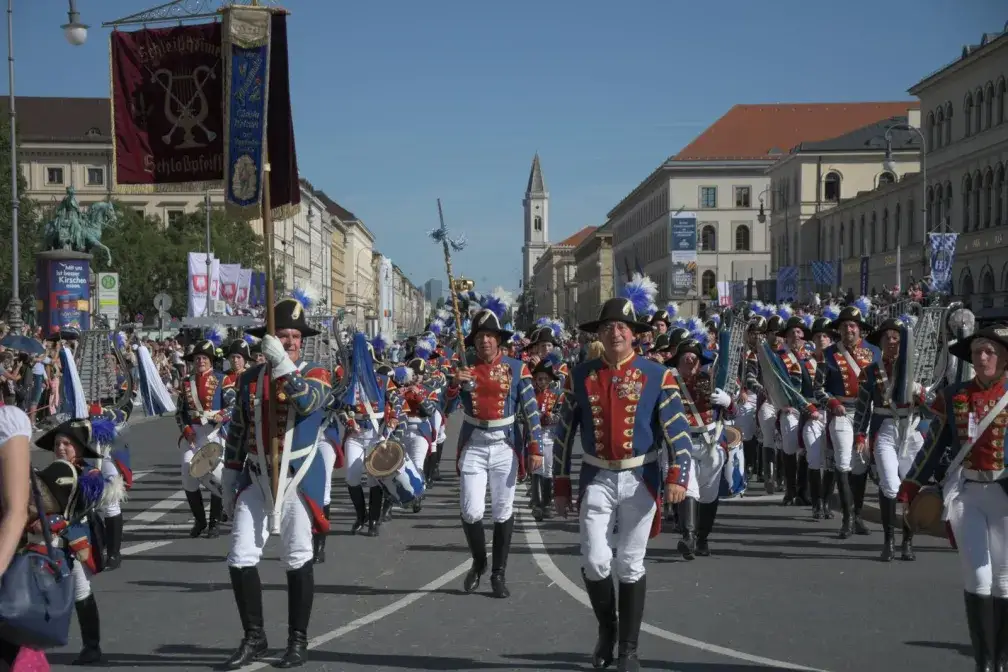
Traditional costumes, brass music, magnificent horse-drawn carriages, and seven kilometers of living heritage: On the first Sunday of Oktoberfest, September 20, 2026, more than 8,000 participants will parade from the Max II Monument through downtown Munich to the Theresienwiese festival grounds. For the first time, the new Münchner Kindl, Sina Hochreiter, will lead the parade on horseback.

Plus d'actions
The 2026 Traditional Costume and Marksmen’s Parade at a Glance
- When? Sunday, September 20, 2026, from 10:00 a.m. to approximately noon. The promotional procession featuring Munich businesses begins at 9:25 a.m.
- What? A total of 8,267 participants from 148 groups will parade through Munich in 50 sections—on foot, on horseback, in carriages, and on decorated floats.
- Where? The seven-kilometer route begins at the Max II Monument on Maximilianstrasse and ends at Esperantoplatz next to the Theresienwiese festival grounds.
- Who takes part? Traditional costume and music groups, sport shooters and mountain riflemen, marching and fanfare bands, flag throwers, and guests from several German states and six European countries.
- How much does it cost to watch? Watching from the roadside is free. Grandstand seats cost 40 euros, while a combination ticket for both Oktoberfest parades costs 60 euros.
- How long has the parade existed? The first parade took place in 1835. It has been held annually during Oktoberfest since 1948 and has been organized by the Festring München association since 1956.
Traditional Costumes, Marksmen, and Brass Music in the 2026 Parade

Festively dressed traditional costume groups alternate with brass bands, historical costume associations, sport shooters and mountain riflemen, fanfare bands, and flag throwers. Nearly 3,000 musicians and more than 1,200 sport shooters and mountain riflemen are scheduled to participate. They are joined by the magnificent horse-drawn teams of Munich’s breweries, decorated carriages, and floats presenting traditional crafts and regional customs.
Alongside 6,653 participants from Bavaria, the parade will feature 765 participants from other parts of Germany. Another 849 guests will bring costumes and traditions from Austria, the Netherlands, Poland, Slovenia, Croatia, and Switzerland to Munich. The Bavarian Hunting Association will also participate with hunting dogs and birds of prey.
👉 The parade is especially varied because groups from Munich and throughout Bavaria appear alongside participants presenting costumes, music, and marksmen’s traditions from other regions of Germany and Europe.
Schäffler, the Rote Funken and several anniversaries

One of the special features of the 2026 parade is the Munich Coopers’ Association (Schäffler). The historic Coopers’ Dance is performed only once every seven years and commemorates a Munich tradition that dates back more than 500 years.
Several participating groups are also celebrating anniversaries. The Fischbachau brass band was founded 175 years ago, while the Unterland district of Tyrolean riflemen and the Riesengebirge Traditional Costume Group of Munich are each marking their 60th anniversary. The Chiemgau Alpine Association for Traditional Costume and Customs is celebrating 100 years. The Kölsche Funken rut-wieß von 1823 will bring a touch of Rhineland color to Munich with their red-and-white uniforms. The Weingarten mounted town guard will also take part with its cavalry and fanfare corps.
Sina Hochreiter Leads the Parade as the New Münchner Kindl
There will be a new face at the front of the parade in 2026: Sina Hochreiter will take on the honorary role of the Münchner Kindl for the first time. Born in Munich in 1999, the art historian comes from an Oktoberfest family. Her parents, Michaela and Dieter Hochreiter, operate “Hochreiters Haxnbraterei,” while her mother’s family has been involved in the carnival and amusement business for generations.
Sina Hochreiter will lead the parade riding sidesaddle on “Schorsch,” a French draft horse. Her black-and-yellow Münchner Kindl costume is based on a 1957 design by graphic artist Eduard Ege. Traditionally, the Münchner Kindl leads both the Traditional Costume and Marksmen’s Parade and the procession of Oktoberfest landlords and breweries. The Münchner Kindl also represents Munich at numerous other events.
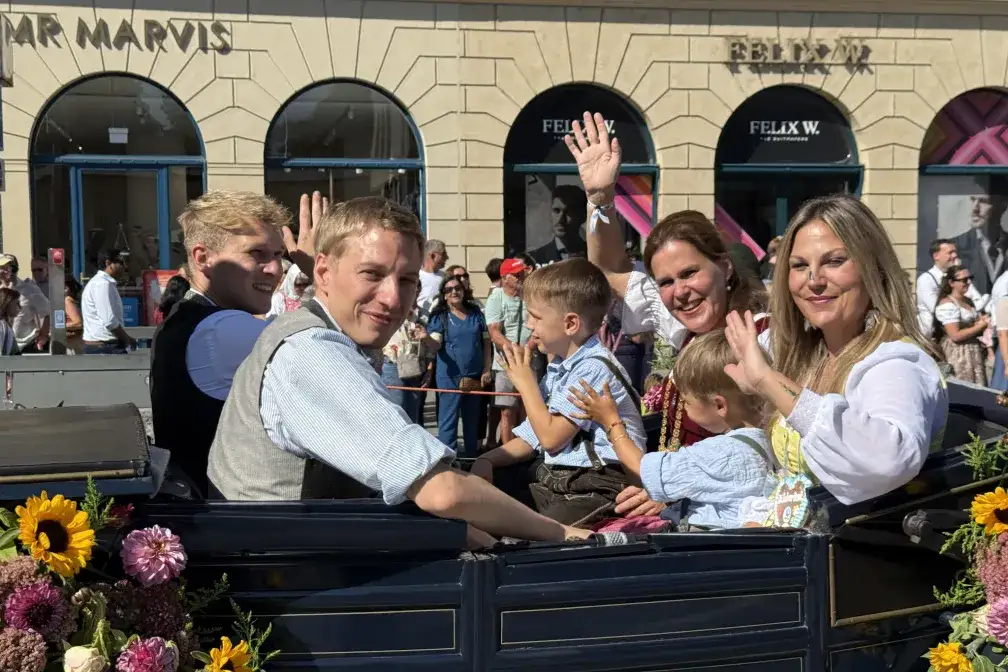
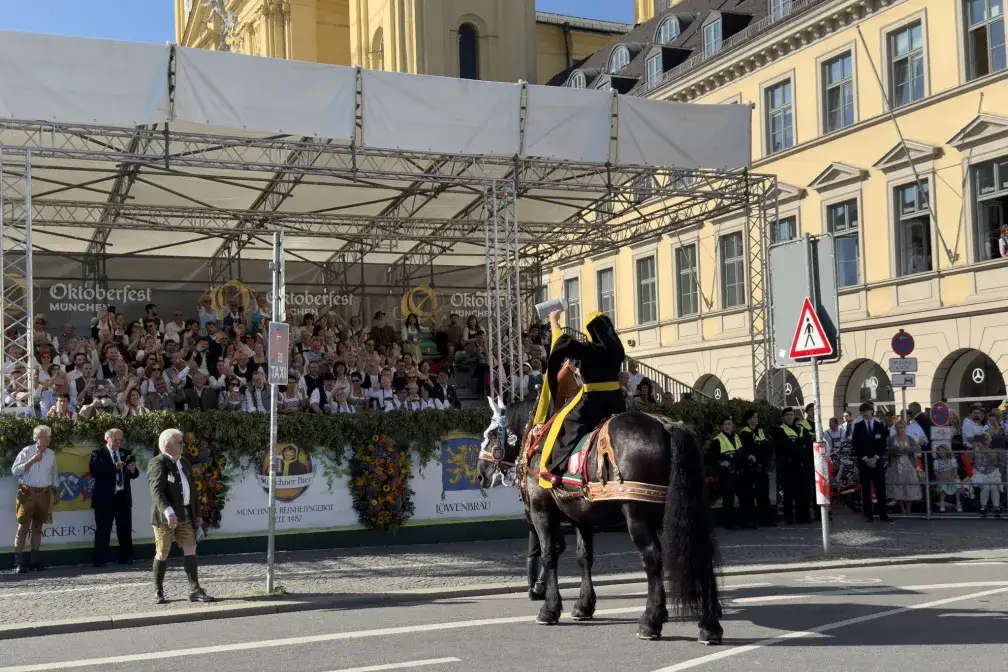
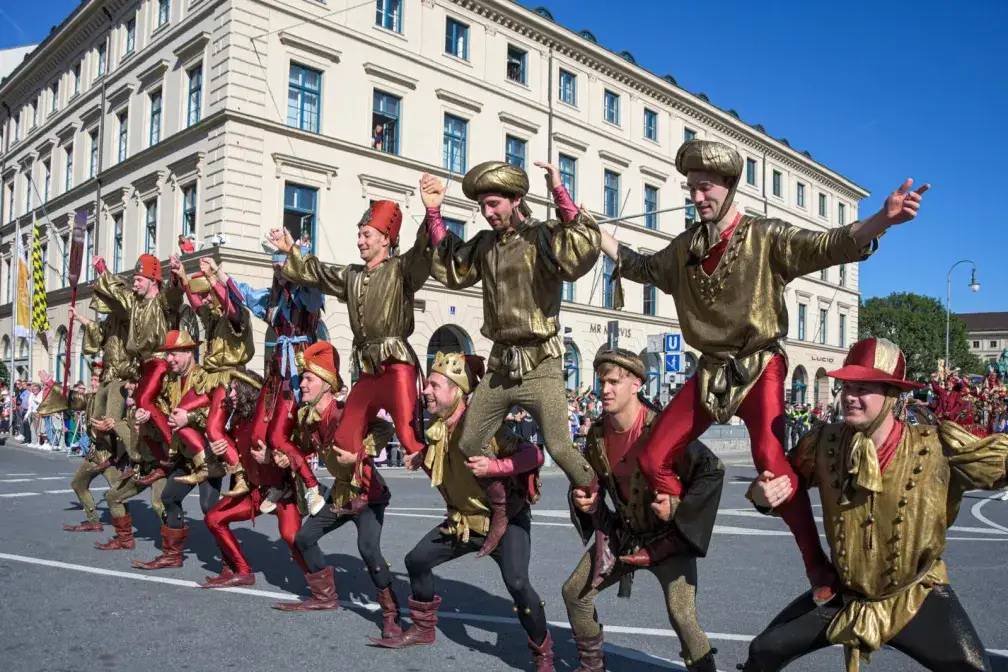
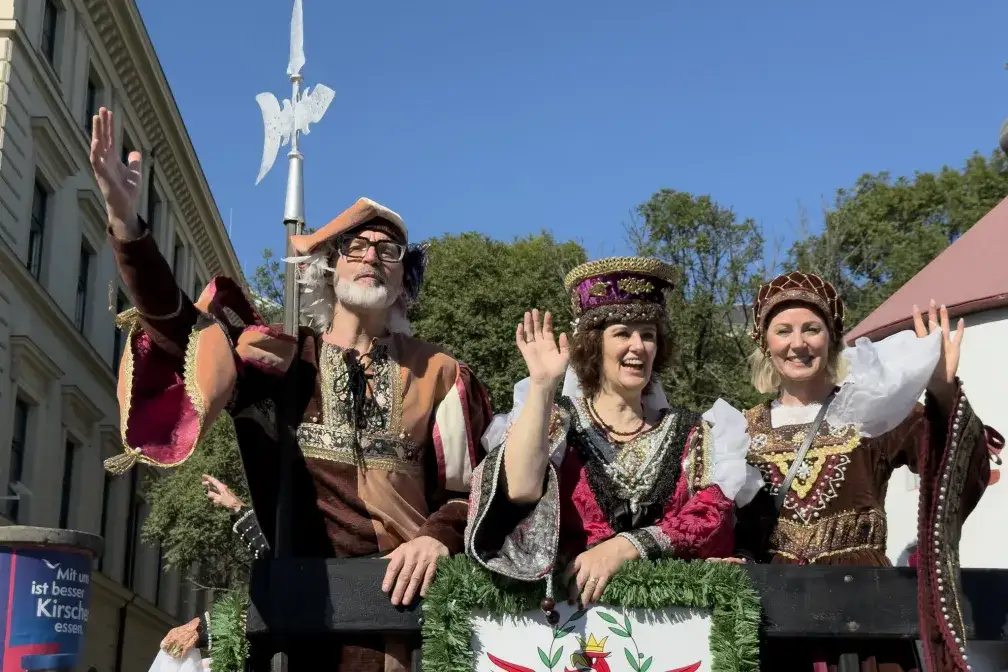
Parade Route from the Max II Monument to Theresienwiese
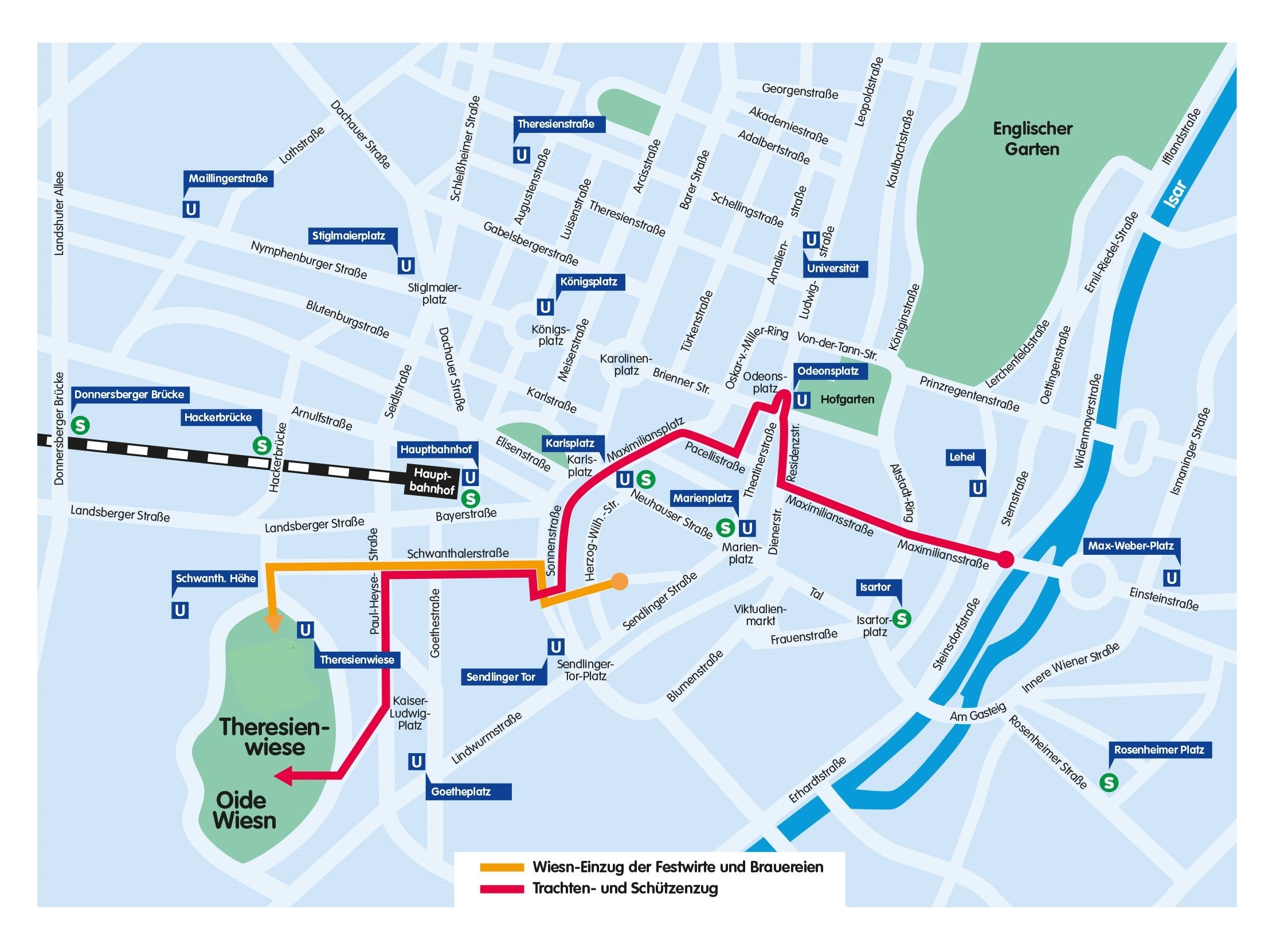
The Traditional Costume and Marksmen’s Parade begins at the Max II Monument on Maximilianstrasse. From there, the route continues along:
Maximilianstrasse – Residenzstrasse – Odeonsplatz and the Feldherrnhalle – Ludwigstrasse – Brienner Strasse – Amiraplatz – Kardinal-Faulhaber-Strasse – Promenadeplatz – Pacellistrasse – Lenbachplatz – Karlsplatz/Stachus – Sonnenstrasse – Schwanthalerstrasse – Paul-Heyse-Strasse – Kaiser-Ludwig-Platz – Schubertstrasse – Esperantoplatz.
The parade officially starts at 10:00 a.m. Because the procession itself is around seven kilometers long, it reaches the later sections of the route with a corresponding delay. Traveling by subway, commuter train, streetcar, or bus is therefore recommended.
👉 At Odeonsplatz, the parade passes the Feldherrnhalle, Theatine Church, and Munich Residence, creating a particularly impressive historic backdrop. Other central viewing areas include Max-Joseph-Platz, Stachus, and Sonnenstrasse.
Route
Grandstand Seats and Parade Tickets
Watching the parade from the roadside is free. Visitors who prefer a reserved seat can purchase grandstand tickets in advance. Grandstands are located at several points along the route, including Maximilianstrasse, Max-Joseph-Platz, the area around Odeonsplatz, Stachus, Sonnenstrasse, and Kaiser-Ludwig-Platz.
A seat for the Traditional Costume and Marksmen’s Parade costs 40 euros, including the advance booking fee. A combination ticket costs 60 euros and also includes the procession of the breweries and Oktoberfest landlords on Saturday. Tickets are available through München Ticket.
History: How Long Has the Traditional Costume and Marksmen’s Parade Existed?

The parade is almost as old as Oktoberfest itself. The first major procession took place in 1835 to celebrate the silver wedding anniversary of King Ludwig I and Therese of Bavaria. At the same time, Munich marked the 25th anniversary of Oktoberfest. More than 1,000 participants and 86 floats presented scenes from everyday life in the Kingdom of Bavaria.
Additional parades were initially held only for special occasions, including events in 1842, 1895, the 100th anniversary of Oktoberfest in 1910, and another parade in 1935. The Traditional Costume and Marksmen’s Parade has been held annually since 1948. The Festring München association has organized it since 1956. Today, the procession is one of the best-known events associated with Oktoberfest and is also broadcast live on television.
Frequently Asked Questions About the Traditional Costume and Marksmen’s Parade
Is the Traditional Costume and Marksmen’s Parade Free?
Yes. You can watch the parade free of charge from the roadside along the entire route. Only reserved seats in the grandstands require a ticket.
Where Does the Traditional Costume and Marksmen’s Parade Begin?
The parade begins at the Max II Monument on Maximilianstrasse. This starting point should not be confused with the Maximilianeum, which is located farther east.
What Time Should Visitors Arrive Along the Route?
The promotional procession begins at 9:25 a.m., while the main Traditional Costume and Marksmen’s Parade starts at 10:00 a.m. At popular locations such as Odeonsplatz, Stachus, and Maximilianstrasse, it is advisable to arrive early to secure a good viewing spot.
Where Does the Traditional Costume and Marksmen’s Parade End?
The parade ends at Esperantoplatz next to the Theresienwiese festival grounds. From there, the participating groups continue onto the Oktoberfest grounds.