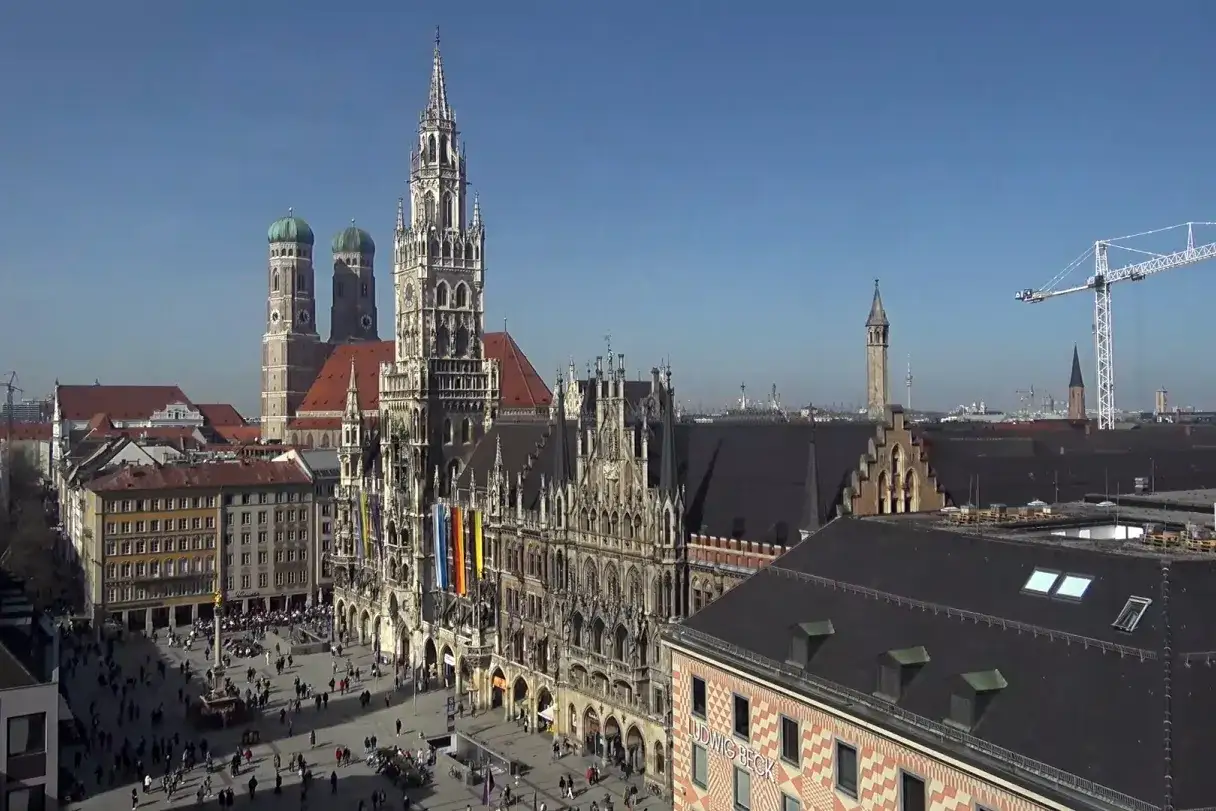
Fantastic view and a lot of city history
The New Town Hall: Viewpoint, architecture, glockenspiel and more
The New City Hall on Munich’s Marienplatz is not only the seat of the mayor and the city council, but is also famous for its observation tower and the famous glockenspiel. The Neo-Gothic façade looks much older than it actually is: the building wasn’t completed until 1905.
Here you can find out when the glockenspiel plays, how to get up the town hall tower, which rooms you can visit—and what else is hidden behind the nearly 100-meter-long facade.

More actions
New Town Hall at a glance
- Where? Marienplatz 8, 80331 Munich – right next to the Marienplatz S-Bahn and U-Bahn station
- What? Neo-Gothic City Hall (completed in 1905) with a carillon, observation tower, ceremonial courtyard, and shops in the arcades
- Carillon: daily at 11 a.m. and 12 p.m.; from March through October, additionally at 5 p.m. – free to view from Marienplatz
- City Hall Tower: daily from 10 a.m. to 8 p.m., last ascent at 7:40 p.m., tickets starting at 7 euros for a 20-minute time slot
- Guided tours: City Hall tours by Munich Tourism starting at 28 euros, Fridays through Sundays
- Accessibility: Meeting rooms, the Grütznerstube, and the Ratstrinkstube are fully accessible; access to the tower is only partially accessible
The Glockenspiel - Munich City History

A well-known spectacle causes crowds to gather daily on the already very bustling Marienplatz. Right on time at 11 a.m. and 12 p.m.—and from March through October, additionally at 5 p.m.—the carillon in the Town Hall tower reenacts two events from Munich’s history:
- The upper level depicts the wedding of Duke Wilhelm V to Renate of Lorraine, celebrated in February 1568: In honor of the newlyweds, a jousting tournament was held on Marienplatz at that time. In the tournament, the Bavarian knight triumphed over his opponent from Lorraine—a total of 16 figures make up this scene.
- The lower level depicts the Coopers’ Dance: After a severe plague epidemic, the coopers are said to have been the first to venture back onto the streets, cheering up the population, who were terrified by the plague, with their dancing.
- Every evening at 9 p.m., the Münchner Kindl is put to bed to the music from Richard Wagner’s *Die Meistersinger von Nürnberg* and Johannes Brahms’ *Lullaby*—accompanied by a night watchman and the Angel of Peace.
- By the way: With its 43 bells, the carillon is one of the largest in Germany. All the bells together weigh about seven metric tons. It underwent extensive restoration in 2007 and is powered by solar energy.
👉 The carillon in the tower of the New City Hall on Munich’s Marienplatz plays daily at 11 a.m. and noon; from March through October, it also plays at 5 p.m.—and it’s free to watch.
Viewing gallery in the Hall tower
All year round, for a small admission fee, you can climb the City Hall Tower, which offers a spectacular view of the Old Town – and on a clear day, you can even see as far as the Alps. Unlike the tower of the Old St. Peter’s Church, you don’t have to climb any stairs here: Two elevators take you to the top – the first goes up to the 4th floor, where you switch to the second elevator to reach the observation deck of the 85-meter-high tower, at the top of which the Münchner Kindl watches over the city. All around you, the Frauenkirche, Old St. Peter’s Church, Old City Hall, and Theatinerkirche lie at your feet.
Visits are organized in 20-minute time slots, with a maximum of 30 people allowed on the platform at any one time. Tickets start at 7 euros—available online without waiting in line or on-site at the Tourist Information office in City Hall (check opening hours!). Free cancellation is possible up to 24 hours before your visit. The meeting point is the 4th floor of the City Hall tower; the first elevator is located in the passageway leading to the Prunkhof. Important: Backpacks and large bags are not permitted; you can leave them with the attendant. Accessibility to the tower is limited.
The tower is open daily from 10 a.m. to 8 p.m., with the last elevator ride at 7:40 p.m. Closed on: Jan. 1, Jan. 6, Shrove Tuesday, May 1, Nov. 1, Dec. 25, Dec. 26.
By the way: Want to admire the New City Hall from above? Then it’s worth climbing the Old Peter tower directly across the street.
👉 You can reach the observation deck of the 85-meter-high City Hall tower on Marienplatz daily from 10 a.m. to 8 p.m. via two elevators—tickets for a 20-minute time slot start at 7 euros.
The Tower Clock: A Mosaic Dial
If you look up before taking the elevator, you’ll spot the large tower clock on the City Hall tower: Its dial consists of an ornate mosaic, making it a small work of art in its own right high above the city. The mosaic dial was last extensively restored by the Department of Public Works in 2025—a 57-meter-high lifting platform was set up specifically for this purpose on Marienplatz.
Law library and interiors

The Law Library is nearly ten meters high and is considered one of the city’s most beautiful libraries:
- In particular, the gilded wrought-iron spiral staircases, the surrounding balustrades, and the large bookshelves reflect Munich’s floral Art Nouveau style—Hauberrisser designed the interior as a total work of art, a striking contrast to the Neo-Gothic style of the rest of City Hall.
- The two-story reading room facing the Prunkhof was completed in 1905, and the library moved in in 1906. It covers a total area of 120 square meters and is located in the original “Book Collection of the Municipal Colleges.”
- It is open to all citizens – behind the historic interior lie Wi-Fi, data lines, and a modern lighting concept.
👉 The Law Library in the New City Hall, with its gilded Art Nouveau spiral staircases, is considered one of Munich’s most beautiful libraries and is open to the public.
Exciting tours and exhibitions

If you’d like to gain fascinating insights into the history and architecture of the New City Hall, the guided tours offered are the best way to do so:
- When: The tours of the City Hall, which last about 90 to 120 minutes, take place on Fridays at 6:00 p.m., Saturdays at 10:30 a.m., 11:30 a.m., and 3:30 p.m., and on Sundays at 11:30 a.m. and 1:30 p.m. Additional dates on public holidays in 2026: Jan. 6, Apr. 3, Apr. 6, May 1, May 14, May 25, and June 4.
- Where: Meet at the Tourist Information office in front of City Hall on Marienplatz, about ten minutes before the tour begins.
- Tickets: Tickets start at 28 euros per person—bookable online (recommended) or at the Tourist Information office. Discounts are available for children, among others.
- Also: Exhibitions are held regularly in the former ticket hall, now known as the Rathausgalerie. The 245-square-meter space, vaulted with a glass roof and supported by 20 granite columns and pillars, has served as an exhibition hall since 1979. The exhibitions focus on the city, its residents, and its history.
👉 Guided tours of Munich’s New City Hall depart Fridays through Sundays from the Tourist Information office at Marienplatz and cost 28 euros per person and up.
The Chambers in City Hall: Where the City Council Meets

Inside City Hall, there is an abundance of granite and marble, as well as the magnificent council chambers, the messengers’ and committee room, and Room 200. It is also known as the Hauberrisser Room and is one of the few official offices still preserved in their original state, complete with furnishings. The originally furnished messengers’ room, with its nearly floor-to-ceiling neo-Gothic oak cabinet complete with a built-in clock, serves as the entrance area to the halls.
The Grand Council Chamber is the largest room in the New City Hall—this is where the plenary sessions of the Munich City Council take place. The hall is dominated by Karl von Piloty’s colossal painting “Monachia,” which, at over 15 meters wide, spans the entire front wall: It depicts 128 figures from 700 years of Munich’s city history surrounding the personification of the city. Since 2004, the restored giant painting has once again hung in its original place. The dark wooden chairs with their tall, carved backs remind some visitors of Hogwarts. The Small Council Chamber is primarily used for committee meetings and receptions.
Good to know: City Council plenary sessions are open to the public – you can watch them from the visitors’ gallery in the Main Council Chamber without registering. You can find dates and agendas in the city’s Council Information System. The chambers on the second floor are accessible to wheelchair users via elevator.
👉 The Munich City Council meets in the Main Chamber of the New City Hall beneath Pilotys’ monumental painting “Monachia”—you can watch the plenary sessions from the visitors’ gallery without registering.
Where does the mayor sit?
The mayor’s offices are located on the second floor of the New City Hall—the walls of the hallway leading to them feature rotating historical exhibitions on life in Munich. The office itself is open to visitors, but only on Open House days. In addition to the mayor, the building also houses the City Council caucuses and parts of the city administration.
At the invitation of the city: Munich's sports stars celebrate here

The balcony of the New City Hall is certainly the city’s most famous balcony. That’s because FC Bayern Munich celebrates its successes here at the city’s invitation. Thousands of fans then gather at Marienplatz to cheer on the team. The FCB women’s team has also celebrated its titles here. The same goes for TSV 1860, which, for example, celebrated its promotion to the Bundesliga in 1977 with its fans in the heart of Munich.
👉 On the balcony of the New City Hall on Marienplatz, Munich teams like FC Bayern celebrate their titles—in front of thousands of fans gathered in the square.
The exterior facade: figure play and history

The facade of the New City Hall is particularly impressive and the centerpiece of Marienplatz. It measures 98.5 meters in length and offers plenty of space for ornamentation and a variety of sculptural figures:
- From the city’s founder, Henry the Lion, to nearly the entire line of the Wittelsbach dynasty, the main facade features the most extensive cycle of princely figures on any German city hall.
- At the corner of Weinstraße – the Wurmeck – a mighty dragon serves as a reminder of the threat posed by the plague. Further down Weinstraße, you’ll find more of Munich’s unique features: gargoyles, grotesques, and masks, as well as allegorical images, saints, and legendary figures.
- Above the tower’s ceremonial entrance, the “Königslaube” (King’s Arbour) gleams with statues of four Bavarian kings – from Maximilian Joseph I to Ludwig II. Behind it lies the tower chamber, once the First Mayor’s reception room, offering a magnificent view of Marienplatz and the Mariensäule.
- At the top of the City Hall tower stands the Münchner Kindl. It was created by Anton Schmid, using his nine-year-old son Ludwig as a model.
The different construction phases are also evident on the facade: the older eastern section is built of brick, while the newer western wing, including the tower, is made of light-colored tuff. The transition is marked by the 2.90-meter-tall equestrian statue of Prince Regent Luitpold.
👉 The 98.5-meter-long facade of the New City Hall on Marienplatz features the Wittelsbach Princes Cycle, the most extensive figurative decoration of its kind on a German city hall.
Arcades and Shops: Shopping Around City Hall

What many people don’t know: Hidden behind the pointed-arch arcades on the ground floor are numerous small shops that circle City Hall—from Marienplatz through Weinstraße and Landschaftstraße all the way to Dienerstraße. The Tourist Information office on Marienplatz is also located here: It’s the central hub for tower tickets, guided tours, city maps, and advice.
The historic Ratskeller, which occupies almost the entire basement of City Hall, is currently closed.
👉 Small shops line the arcades on the ground floor of the New City Hall, encircling the entire building complex—with the Tourist Information office on Marienplatz right in the middle.
The Courtyards: The Prunkhof and Five Other Courtyards

The New City Hall is arranged around a total of six courtyards. The Prunkhof is open to the public; you can reach it through the tower portal on Marienplatz or the entrance on Weinstraße:
- The mosaic on its floor forms a huge labyrinth.
- The Staircase of the Ages on the west side of the courtyard symbolizes the different stages of life: from a little boy to a hunchbacked old man.
- At the entrance to the former ticket hall (now the City Hall Gallery), a stone dog wags its tail in a friendly greeting to everyone bringing money into the city coffers—opposite it, a pug growls at those carrying money out.
👉 The New City Hall’s Grand Courtyard, which is open to the public and features a labyrinth mosaic and the “Staircase of the Ages,” is accessible from Marienplatz and Weinstraße.
History: Three Construction Phases and a Reconstruction

Because the Old City Hall had become too small for the rapidly growing city administration, the New City Hall was built in three construction phases—all under the direction of architect Georg von Hauberrisser:
- 1867 to 1874: The first wing is built—with delays and massive cost overruns, forcing Hauberrisser to drastically simplify his plans. In August 1874, the first city employees moved into their offices; the elaborate interior work continued until 1883. At the time, the city was particularly proud that nearly all the work was carried out by Munich-based companies and craftsmen.
- 1889 to 1892: First expansion at the corner of Dienerstraße and Landschaftstraße, seamlessly integrated into the existing structure.
- 1898 to 1905: Second expansion into a four-sided complex featuring the City Hall tower. The planned height of the tower, in particular, stirred up public opinion—but the city remained undeterred. With the placement of the keystone on the tower in December 1905, the structural work was completed, and by the end of 1906, almost all office spaces had been occupied.
The entire complex forms an irregular quadrilateral with a floor area of 9,159 square meters—with frontages of 98.5 meters on Marienplatz, 85 meters on Dienerstraße, 111 meters on Landschaftstraße, and 86 meters on Weinstraße.
During World War II, the New Town Hall sustained significant damage: Nearly all sections of the roof were destroyed by fire; on the facades, in addition to many decorative elements, five statues of Bavarian rulers were destroyed; and parts of the wing facing Landschaftstraße were completely lost. After the war ended, the building was gradually rebuilt—the carillon rang out again as early as September 14, 1945.
👉 The New City Hall in Munich was built in three construction phases from 1867 to 1905 and, with a floor area of 9,159 square meters, encompasses an entire block in the Old Town between Marienplatz, Dienerstraße, Landschaftstraße, and Weinstraße.
Brief Profile: Architect Georg von Hauberrisser
- Born in 1841 in Graz, died in 1922 in Munich
- He was only 25 years old when he submitted his competition design for the New City Hall
- He oversaw the construction throughout all three phases, spanning nearly 40 years
- He drew inspiration from the Gothic city hall architecture of Flanders
- He also designed the Art Nouveau interior of the Law Library as a total work of art
- Other works: the early Gothic St. Paul’s Church and his residence on Schwanthalerstraße in Munich, as well as the city halls of Kaufbeuren, Wiesbaden, and Saarbrücken
Events at City Hall
The New City Hall is not only the seat of government but also an event venue:
- Exhibitions: The City Hall Gallery in the Prunkhof Wing regularly hosts rotating exhibitions focusing on Munich and its history.
- City Hall Clubbing: Once a year, on Christopher Street Day, you can celebrate wild nights at Marienplatz during City Hall Clubbing.
- Legal Library: The library offers a high-quality program of events for culture enthusiasts.
- Celebrations: The Grütznerstube and Ratstrinkstube host municipal celebrations and press conferences – the Ratstrinkstube, with its cross-ribbed vault, can also be rented for select events.
- Open House: On this day, rooms that are otherwise off-limits are opened to the public – including the mayor’s office.
Good to Know: Trivia About City Hall

- The construction blew the budget: The initial budget for the first phase was 550,000 guilders—but in the end, it cost 2,722,654 marks, including the construction site. This meant the original budget was exceeded by more than ten times.
- Around 1897, the planned height of the City Hall tower sparked heated debate among Munich residents—but the city went ahead with the construction anyway.
- Pilot’s “Monachia” in the Grand Council Chamber immortalizes 128 notable figures—only seven of whom are women.
- Above the porter’s lodge at the main entrance hangs a clock with a banner reading: “I wish only to show the good hours, but to keep the bad ones hidden.”
- The “Münchner Kindl” at the top of the tower is based on a real person: the sculptor’s nine-year-old son, who later became known as the popular actor Ludwig Schmid-Wildy.
- After World War II, the carillon rang out again as early as September 14, 1945—restored at the express request of the American military government.
- Five portraits by the painter Eduard Grützner still hang in the Grütznerstube today—including a self-portrait of the artist.
- At the Fischbrunnen fountain in front of City Hall, the mayor washes the city’s purse every year on Ash Wednesday during the traditional “money purse washing” ceremony—those who participate are said to have no financial worries for the rest of the year.
Services and Directions
Address: New City Hall, Marienplatz 8, 80331 Munich
Directions: Take the S-Bahn (all lines) or U-Bahn (U3/U6) to Marienplatz—the main entrance is right on the square. The City Hall is located in the middle of the pedestrian zone; traveling by car is not recommended.
Tourist Information: in the City Hall arcades on Marienplatz – tickets for the tower and guided tours, city maps, and information.
Accessibility at the New City Hall
The following rooms in City Hall are accessible:
Large Council Chamber
Small Council Chamber
Grütznerstube
Ratstrinkstube
You can reach the halls on the second floor by elevator; accessible restrooms are available. Access to the tower is only partially accessible—check with Munich Tourism in advance for details.
FAQ: Munich's New Town Hall
When does the Glockenspiel at Marienplatz play?
Daily at 11 a.m. and 12 p.m., plus an additional performance at 5 p.m. from March through October. At 9 p.m. each evening, the Münchner Kindl is musically tucked into bed.
What does the Glockenspiel show?
Two events from Munich's history: on the upper level, the jousting tournament held for the wedding of Duke Wilhelm V in 1568, and below it, the Schäffler dance performed after the plague epidemic.
How much does the Town Hall tower cost?
Tickets for the tower ride start at 7 euros for a 20-minute time slot – available online or at the Tourist Information office at Marienplatz. Discounted tickets are only valid with proof of eligibility.
How do you get to the top of the Town Hall tower?
By two elevators: The first takes you to the tower's 4th floor, where you switch to a second elevator that brings you up to the observation platform. No stair climbing required.
How tall is the Town Hall tower?
The tower stands 85 meters (about 280 feet) tall, crowned by the Münchner Kindl. On clear days, the observation platform offers views all the way to the Alps.
Is there an admission fee for the New Town Hall?
No – the Prunkhof courtyard, the arcades, and the Law Library are free to visit. Only the tower ride (from 7 euros) and the guided tours (from 28 euros) require tickets.
Can you visit the inside of the New Town Hall?
Yes: The Prunkhof courtyard is open to everyone, the Law Library is free to enter, and the historic halls can be seen on a guided tour offered by Munich Tourism (from 28 euros).
Can you attend a City Council session?
Yes, the City Council's plenary sessions in the Grand Council Chamber are open to the public – no registration is required for the visitors' gallery. Session dates are listed in the city's council information system.
How old is the New Town Hall?
The New Town Hall was built in three phases between 1867 and 1905 – making its oldest section more than 150 years old. Despite its Gothic appearance, it's much younger than many visitors assume.
What's the difference between the New and the Old Town Hall?
The New Town Hall on the north side of Marienplatz is the seat of the mayor, the City Council, and the city administration. The Gothic Old Town Hall on the east side of the square is considerably older and now houses the Toy Museum.