
Municipal museum: An artist’s home as a total work of art
Museum Villa Stuck
Museum Villa Stuck presents temporary exhibitions that complement the house’s elaborate interiors. In this former artist’s home, architecture, art, and intricately designed rooms come together to form a total work of art.

More actions
Villa Stuck: Key information at a glance
- Location: On the elevated eastern bank of the Isar, near the Friedensengel (Angel of Peace)
- Museum category: Art
- Children’s program: A range of classes and plenty of opportunities to get creative
- Recommended visit duration: 1–4 hours
- Getting there: Take bus 100 or tram 17 to Friedensengel/Villa Stuck, the U4 subway to Prinzregentenplatz, or the U5 subway to Max-Weber-Platz
Why visit Villa Stuck?

Villa Stuck is one of Europe’s most important surviving artists’ homes. Franz von Stuck conceived it in the late 19th century as a total work of art.
What can you experience? The former home of artist Franz von Stuck (1863–1928) is now an internationally renowned museum. World-famous paintings are displayed in a compelling dialogue with the historic building. The luxurious rooms offer authentic insights into von Stuck’s architecture, life, art, and music. Several special exhibitions each year explore the art of the 19th and 20th centuries as well as contemporary art.
What makes it special? The historic building is just as extraordinary as the art inside! A particular highlight is the music room’s ceiling, designed as a celestial vault adorned with golden stars and signs of the zodiac. The artist’s garden behind the villa combines Pompeian influences with works of art from the 19th century and invites visitors to linger. The museum café, Stuckkantine, serves coffee, homemade cakes, and seasonal lunch dishes, including vegetarian and vegan options.
Permanent exhibition: Franz von Stuck’s total work of art

Every part of the museum enters into a dialogue, making Villa Stuck a distinctive place to experience art. The artist’s villa, collections, temporary exhibitions, educational program, and visitor facilities all relate to one another, creating space for new perspectives.
The collections explore the work of Franz von Stuck and international Art Nouveau. The museum’s program reflects the diversity of art and culture from the 19th century to the present. Here is what you should see:
- Villa Stuck’s historic rooms feature many works by the artist, including paintings such as “Sin” and “The Guardian of Paradise,” which stands over two meters tall.
- The antique furniture and remarkable interior design testify to von Stuck’s many talents.
- Special exhibitions featuring different themes and artists are also held several times a year



A tour of the rooms and interiors

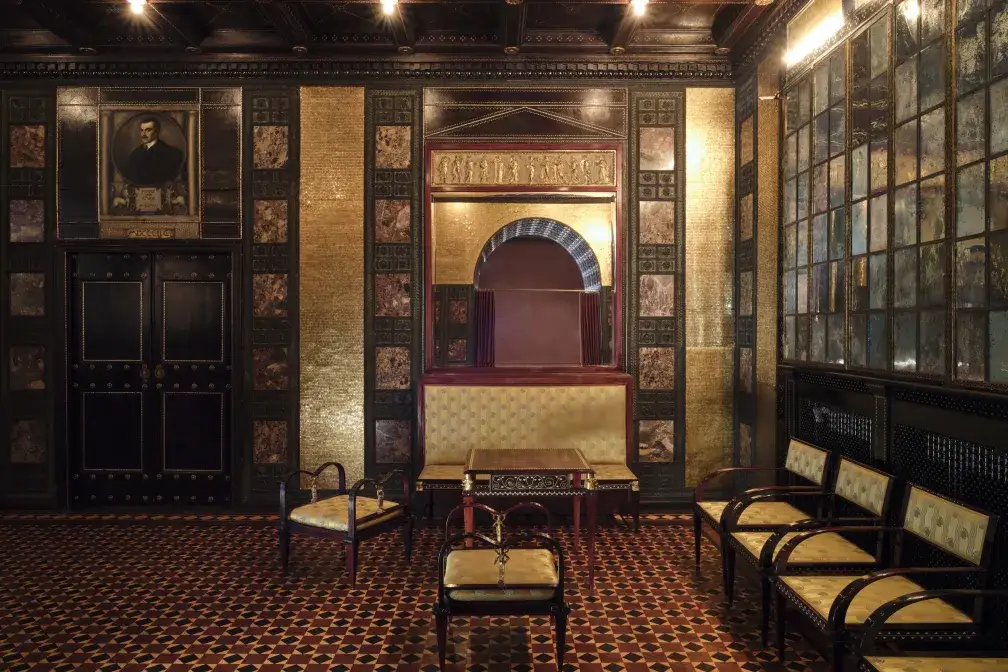
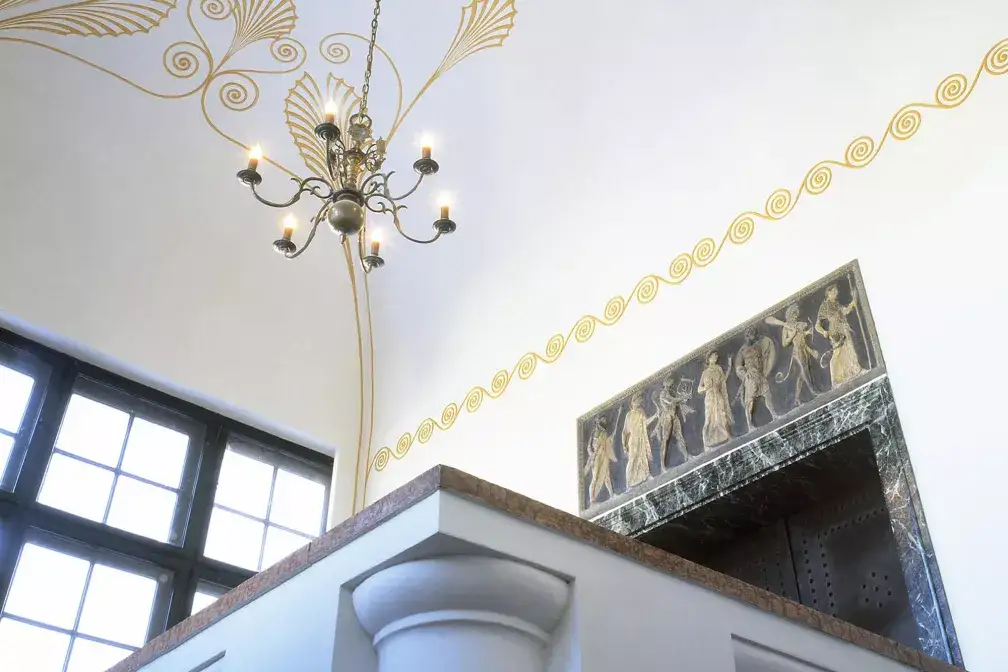
Villa Stuck’s palatial, neoclassical building was designed to serve as both a home and an artist’s studio. Visitors now wander from room to room through spaces that once hosted lively celebrations and heated discussions about art. You can visit the vestibule, reception room, music room, staircase, and the artist’s old studio. Every detail bears Franz von Stuck’s signature. The villa combines elements from classical antiquity, Byzantium, the Orient, and the High Renaissance with the modern art of the late 19th century. Even during Stuck’s lifetime, it was considered a distinctive total work of art.
The old studio of the celebrated painter lies at the heart of the house and resembles a small ballroom more than a workspace. There is no sign of palettes, brushes, blank canvases, or preliminary sketches. Instead, tapestries, an elaborate parquet floor, and the altar-like setting for Stuck’s scandalous masterpiece “Sin” are just a few of the fascinating features to admire. A wide bank of windows overlooks Prinzregentenstraße. In this room, the painter worked and celebrated himself and his art.
Guided tours of Villa Stuck
- Guided tours are offered in cooperation with the Münchner Volkshochschule (Munich Adult Education Center) and the Museumspädagogisches Zentrum (Museum Education Center).
- As part of its “Einblicke” (“Insights”) series, Villa Stuck offers tours led by the museum’s curators, artists, and staff.
Artist’s Garden and Museum Café: Art and a Break in the Garden

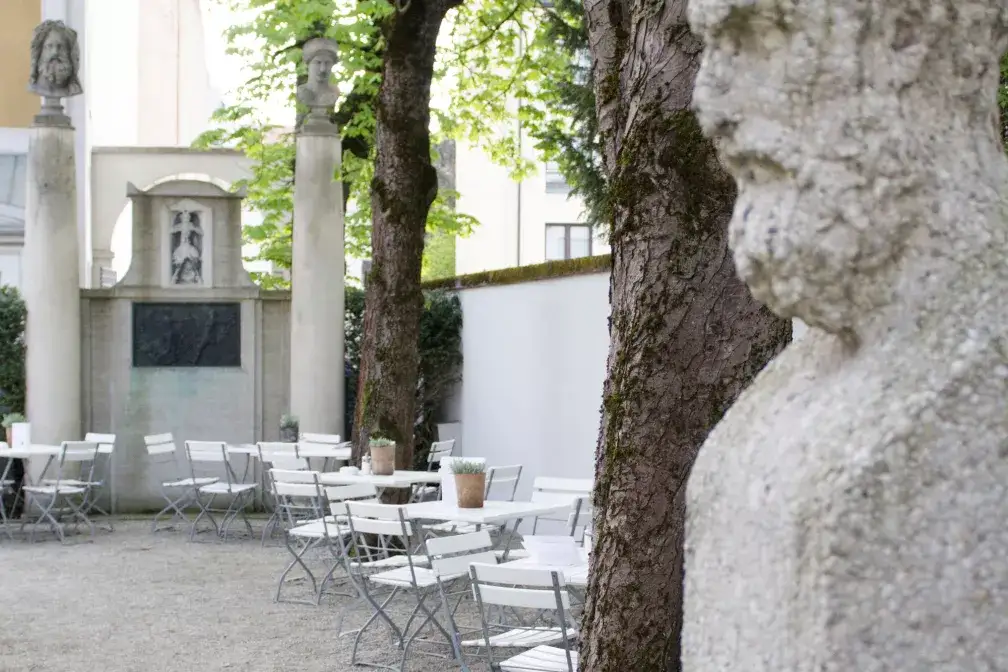
After touring the museum, take a look behind the villa: Here you’ll find the artist’s garden, which Franz von Stuck designed as a secluded space for art, inspired by classical antiquity. Rectangular lawns, a terrace with columned arcades, and a leafy pergola connect the house with the studio building added later.
As you stroll through the garden, you’ll encounter figures from classical mythology: Dionysus, Zeus, and Hera appear alongside Pan playing his flute and Stuck’s “Fighting Fauns.” You can also discover a fountain with a faun’s mask and a bronze sculpture of the Capitoline Wolf. The villa’s total work of art continues outdoors.
For a break, stop by the Stuckkantine museum café. The team from the Roecklplatz training restaurant serves coffee, homemade cakes, and seasonal lunch dishes made with regional ingredients, including vegetarian and vegan options. Its social mission also helps young people from disadvantaged backgrounds explore career opportunities.
To round off your visit, take a walk to the Friedensengel (Angel of Peace), just a few minutes away. From its viewing terrace, you can look along Prinzregentenstraße toward downtown Munich.
Events and Children’s Program

- Friday Late: The first Friday of every month, 6–10 p.m., with free admission and free participation in the evening program.
- Other events: Artist talks, concerts, lectures, and panel discussions complement the exhibition program.
- Fränzchen: The program for children and teens offers classes, school-break workshops, and creative workshops with plenty of opportunities to make art.
- Inclusive museum choir “Stuck-Chor”: Rehearsals take place on Wednesdays from 6–7:45 p.m., except during school breaks. No prior musical experience is needed. New members can join at the start of a project. For more information, contact anne.marr@muenchen.de.
Admission prices
- Children and teens up to age 18: Free admission
- Admission: €9; reduced admission €5
- Annual pass: €25; reduced price €15
Accessibility and programs for people with disabilities
The museum building is fully accessible.
- Special programs include tactile tours, tours in German Sign Language, programs for people with experience of psychiatric care and people with dementia, and an inclusive museum choir.
The history of the artist’s villa on Prinzregentenstraße
Villa Stuck was built in 1897–1898 by the Munich firm Heilmann & Littmann to designs by its owner. Franz von Stuck, then a 34-year-old painter, graphic artist, and sculptor, had planned every detail of his future artistic retreat. From the building’s structure to the smallest details of its interior decoration, Stuck designed everything himself, including the artist’s garden with its impressive sculptures. The villa’s furniture even won a gold medal at the 1900 World’s Fair in Paris.
The three-story villa displays understated Art Nouveau elegance. Two access ramps lead to a bronze entrance featuring a Medusa head beneath a columned portico. Stuck later added colored rectangular panels to the otherwise simple facade.
After Stuck’s death in 1928, his family continued to live in the house. A variety of uses led to extensive alterations through the 1960s. Hans-Joachim and Amélie Ziersch began the first renovation in 1965 and donated the house to the Stuck-Jugendstil-Verein in 1967 so it could operate as a museum. Through a combination of outstanding civic commitment and bold public action, the artist’s villa was donated to the City of Munich in 1992.
In cooperation with the cultural department and the museums
This article about Munich's museums is sponsored by the Cultural Department of the City of Munich and was conceived in cooperation with the State Agency for Non-State Museums in Bavaria. The content has been coordinated between the participating museums and muenchen.de, the official city portal.


At a glance
Villa Stuck EN-neu
Prinzregentenstr. 60
81675
München
Tel:
+4989233524812

1 - 30 of 56 events
-
until
-
until
-
until
-
until
-
until
-
until
-
until
-
until
-
until
-
until
-
until
-
until
-
until
-
until
-
until
-
until
-
until
-
until
-
until
-
until
-
until
-
until
-
until
-
until
-
until
-
until
-
until
-
until
-
until
-
until