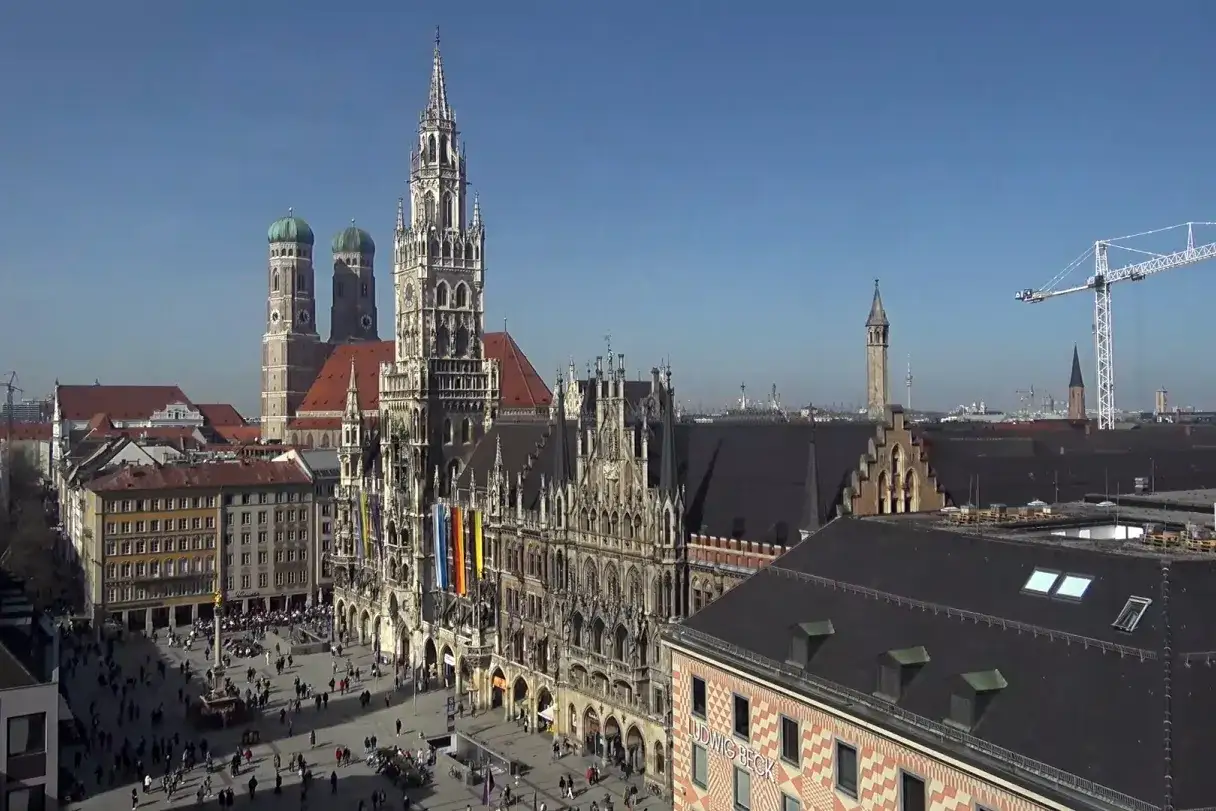
Parque, Monopteros, ola de Eisbach y más
Englischer Garten Múnich - El Jardín Inglés
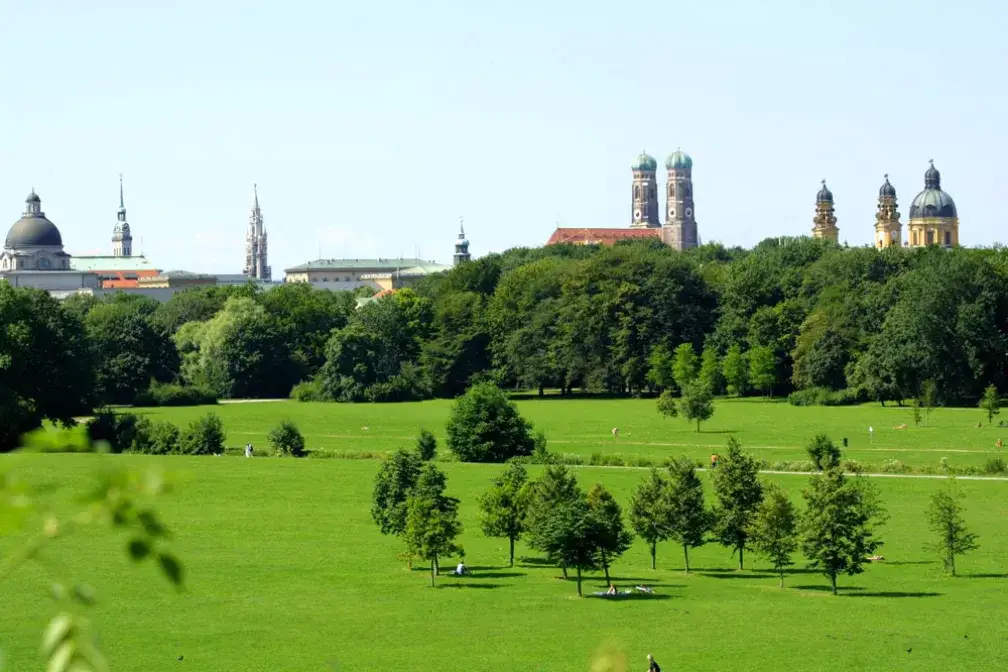
El Jardín Inglés es el parque más grande de Múnich. El famoso Monopteros y las olas de los surfistas se encuentran entre las atracciones aquí.
Más acciones
Quick Overview: The Most Important Facts About the English Garden
- Location: between Altstadt/Lehel, Schwabing, and northern Munich
- Address: Englischer Garten, 80538 Munich
- Hours: Open year-round
- Admission: Free
- Size: 376 hectares; 411 hectares including the Maximiliansanlagen, Hofgarten, and Finanzgarten
- Notable landmarks: Eisbach Wave, Monopteros, Chinese Tower, Rumfordschlössl, Japanese Tea House, Kleinhesseloher Lake
- Notable meadows and areas: Schönfeldwiese, Werneckwiese, Schwabinger Bucht, Hirschau
- Dining: Chinese Tower, Seehaus, Hirschau, Aumeister, Minihofbräuhaus, and several kiosks
- For families: Meadows, children’s carousel, boating on Kleinhesseloher Lake, Rumfordschlössl Nature and Culture Center
- Nature: Flowering meadows, streams, wild bee nature trail, breeding birds, sheep
- Accessibility: Many paths are flat and paved; the path to the Monopteros is not accessible
- Public transportation: Depending on your destination, options include the U3/U6 subway lines, bus to Chinesischer Turm, and tram to Tivolistraße
Why the English Garden Is Worth a Visit
The English Garden is Munich’s largest park—and yet it’s not just a place you “look at.” You walk in and are immediately right in the middle of it all: people are lying on the lawns, joggers crisscross the paths, everyone pauses briefly by the Eisbach, and at the Monopteros, the view over the city opens up.
It’s precisely this mix that defines the park: a beer garden at the Chinese Tower, a tea ceremony in the Japanese Tea House, boating on Lake Kleinhesselohe, theater performances in the amphitheater, carriage rides, flower-filled meadows, sports, and quiet paths in the northern section. The English Garden is a tourist attraction, a daily route, a meeting place, and a natural space all at once.
The park was established in 1789 as a public park and was intended from the outset to be open to the general public. The idea originated largely with Sir Benjamin Thompson, later known as the Imperial Count of Rumford; Friedrich Ludwig von Sckell played a decisive role in shaping its design as a landscape garden.
👉 The English Garden is Munich’s park for just about everything: walking, sightseeing, relaxing, biking, marveling, and stopping for a bite to eat.
Attractions in the English Garden
4 razones por las que amamos el Jardín Inglés
1. El Monopteros es igualmente conocido y popular, y con razón: la vista desde lo alto es espectacular (foto) y la silueta del casco antiguo es aún más impresionante bajo el sol y los colores del otoño. Desde los Monopteros se puede contemplar el Jardín Inglés en sus facetas más bellas.
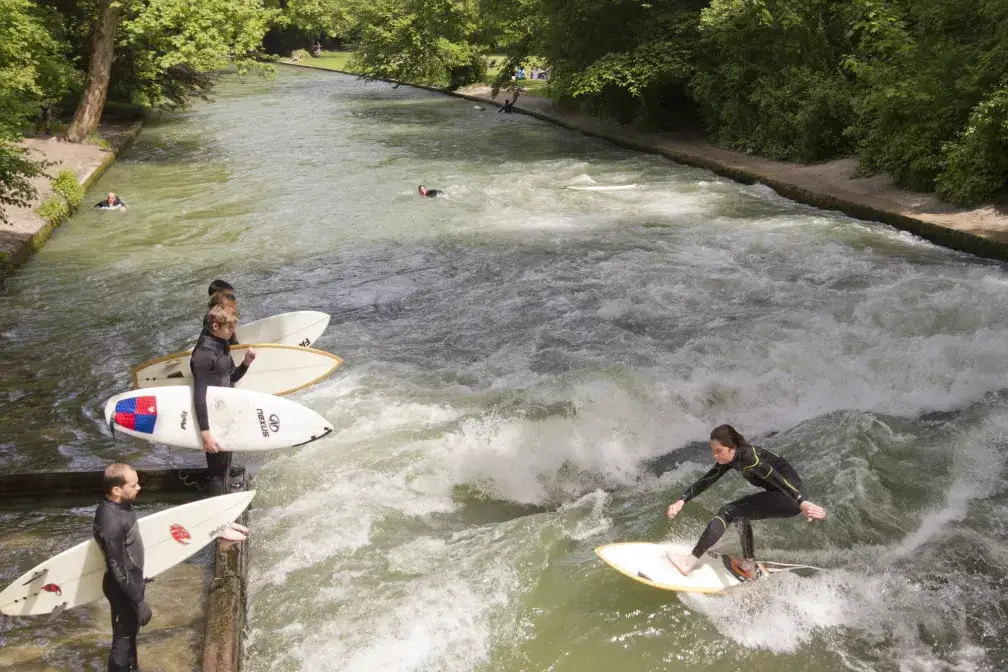
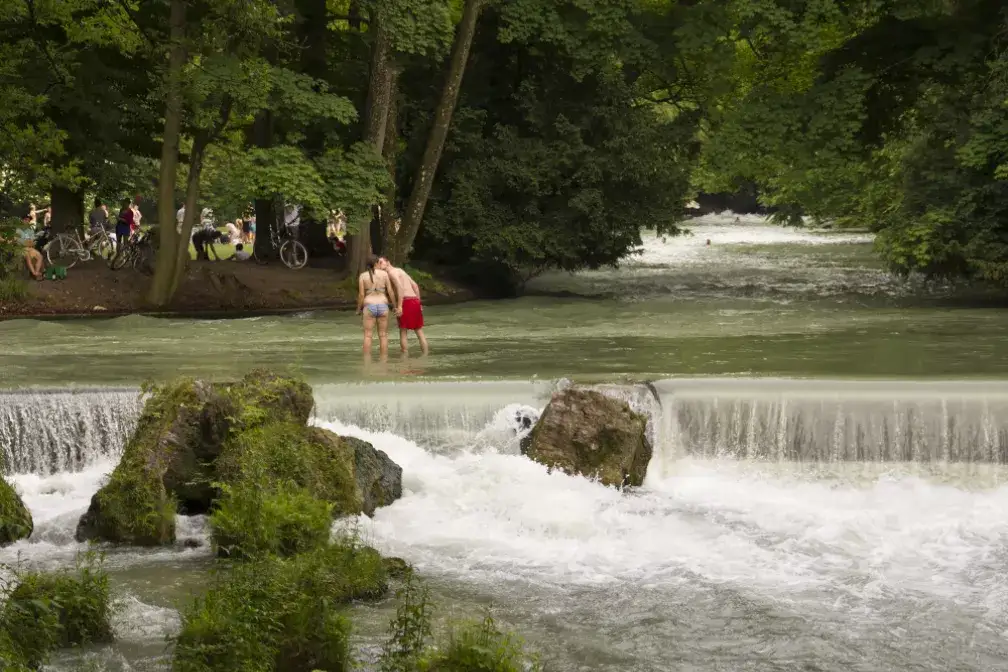
2. Muchos surfistas están todo el año sobre sus tablas en la ola surfista y no tienen miedo el agua fría. ¿Mejor mas idílico? Bueno, también se puede ir a las cascadas cerca de Eisbachwelle como alternativa. Allí es más tranquilo y uno puede buscarse un lugar al sol en uno de los bancos.
3. El mejor consejo para relajarse es caminar hasta el rio Isar y recorrerlo hasta la presa de Oberföhring: extensiones infinitas y el Isar en tamaño natural; en otras ciudades la gente tiene que viajar lejos para algo como esto, Múnich lo tiene justo a la vuelta de la esquina.
4. Algo un poco más romántico: Tomarse el tiempo y caminar por la parte norte del Jardín Inglés hasta el Schwammerlweiher con su pequeña isla. Simplemente siguiendo el Oberstjägermeisterbach, no se puede perder el estanque. Cualquiera que descubra aquí un rastro del estrés cotidiano puede dejarselo.
The Eisbach Wave: Munich’s Famous Surf Spot
Right on the southern edge of the English Garden lies one of Munich’s most famous spots: the Eisbach Wave. Surfers can usually be found here year-round—right in the middle of the city, directly at the park entrance on Prinzregentenstraße, often with crowds of spectators lining the banks.
👉 The Eisbach Wave is located on the southern edge of the park and is one of Munich’s most unusual attractions.
Chinese Tower: Beer Garden, Meeting Place and a Munich Classic
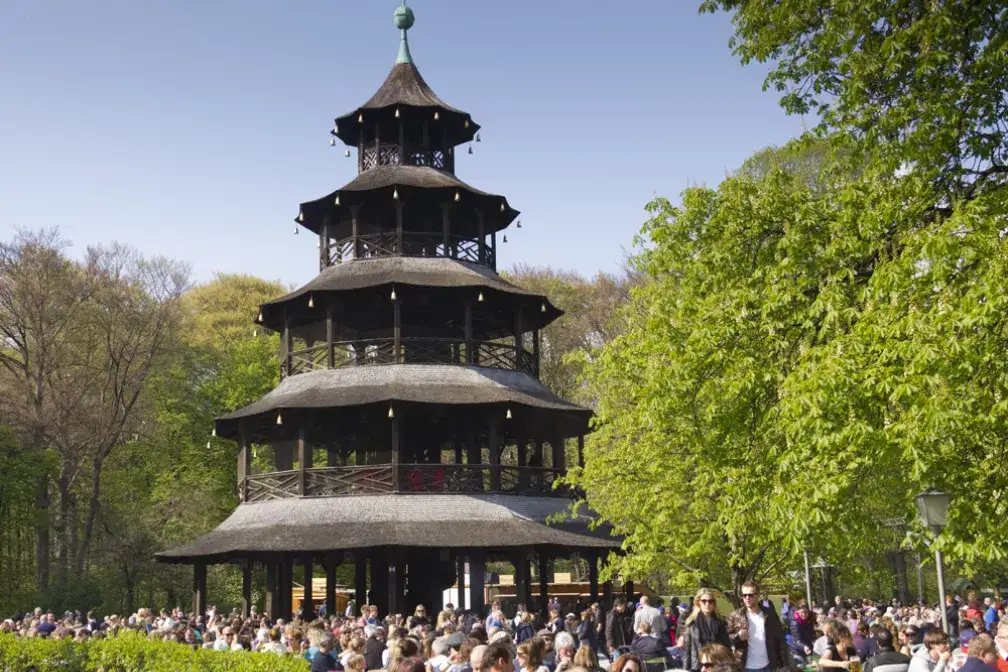
Perhaps the most famous structure in the English Garden is the Chinese Tower. The pagoda-style building, designed in the imperial Chinese style, rises 25 meters high and dates back to a design from 1789. The tower burned down several times but was rebuilt each time—most recently after World War II.
Surrounding the tower is one of Munich’s largest beer gardens. It’s especially lively here in the summer: beer garden benches, brass band music, cyclists, families, tourists, and Munich locals who simply know why they come here. Right next door is a historic Biedermeier-style carousel for children. During Advent, a Christmas market takes place at the Chinese Tower.
👉 The beer garden at the Chinese Tower has around 7,000 seats and is one of the largest beer gardens in Bavaria.
Kleinhesseloher Lake: A Break by the Water, Boating, and Watching Chicks
Kleinhesseloher Lake is the largest body of water in the English Garden. If you continue on from the Chinese Tower, you’ll reach a lovely spot for a longer break: views of the water, walking paths along the shore, the Seehaus right next to it—and in the summer, pedal boats and rowboats on the water. Swimming is not allowed in the lake, but boating is a popular classic activity. The boat rental is located on the northern shore near the Seehaus.
The view of the shore is especially worth seeing in the spring, when waterfowl are often out and about with their young. For many visitors, ducks, geese, and ducklings are part of the Kleinhesseloher See experience. Please keep your distance and do not feed the animals.
👉 At Kleinhesseloher See, the English Garden becomes quieter—with views of the water, boats, and walking paths.
Japanese Tea House: A Place of Tranquility
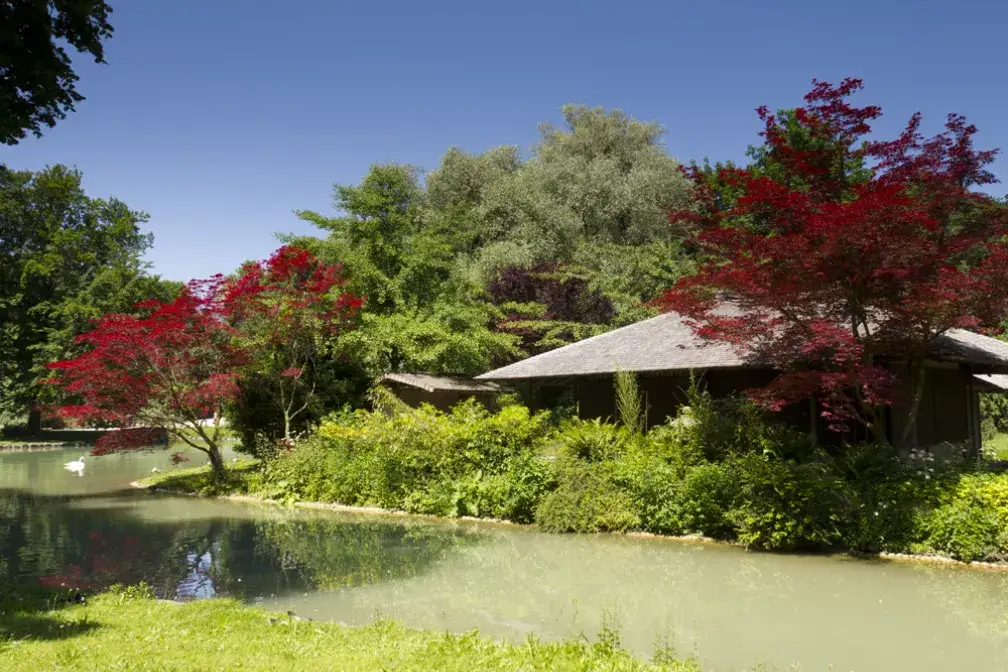
The Japanese Tea House was built in 1972 to mark the Summer Olympics in Munich. Located at the southern end of the park, it stands on an artificial island in the Schwabinger Bach and feels like a small, tranquil haven away from the hustle and bustle of the Eisbach Wave. Fans of Japan meet there regularly for traditional tea ceremonies.
Ducks, swans, and other waterfowl can be spotted in the small pond and the surrounding waters. In the summer, the Japan Festival is also celebrated around the teahouse—featuring culture, music, performances, and Japanese flair right in the middle of the park. For 2026, the Kanshoan Teahouse has scheduled public performances from April through October; the Japan Festival will take place on July 19, 2026.
👉 The Japanese Teahouse showcases the tranquil side of the English Garden—just a few minutes from the Eisbach
Waters in the English Garden: Streams, Ponds, and Waterfalls
The English Garden is characterized by numerous waterways. In the south, the Eisbach, Schwabinger Bach, and the small waterfalls are particularly popular stops; further north, the Oberstjägermeisterbach, Entenbach, and smaller tributaries define the park.
Among the tranquil water spots are Kleinhesseloher See, Schwammerlweiher, and Libellenteich. If you walk north from the southern park entrance, you’ll experience the English Garden not only as a park with meadows and beer gardens, but also as a landscape of streams, bridges, ponds, and quiet spots along the water’s edge.
👉 Streams, ponds, and waterfalls make the English Garden one of the parks with the most water features in Munich.
Other Places in the English Garden
Behind the Chinese Tower lies the Rumfordschlössl, a Neoclassical building dating from 1791. It commemorates Benjamin Thompson, later known as the Imperial Count of Rumford, who played a key role in the creation of the English Garden. Today, it serves as a nature and culture center for children and teenagers—offering programs focused on nature, the environment, and culture.
Further north, the English Garden features the Amphitheater, an open-air stage set amid greenery. In the summer, the Munich Summer Theater performs on the stage beneath old trees; in 2026, Shakespeare’s “Twelfth Night” is on the program (starting July 2, Thursdays through Saturdays, free admission). In case of bad weather, the troupe moves to the Mohr-Villa Freimann.
Those who walk even further toward the northern section can extend their route all the way to the Oberföhring weir. The light beige weir, built in the 1920s, raises the level of the Isar by about six meters and diverts its water into the Mittlere Isar Canal—the intake structure of the 64-kilometer-long canal heading toward Landshut. A wide footbridge on the north side allows you to cross the Isar on foot; since 2022, the structure has also been adorned with large-scale graffiti by the Munich street artists Loomit, Lando, and Bert.
Anuncio
Tour Tip: How to Experience the English Garden on Your First Visit
If you’re visiting for the first time, it’s best to start in the south—for example, at the Haus der Kunst or the Eisbachwelle. From there, head to the Japanese Tea House, up to the Monopteros, and then toward the Chinese Tower and Rumfordschlössl. If you have more time, extend your walk to Kleinhesseloher Lake or further into the quieter northern section.
Southern Route: Eisbachwelle → Japanese Tea House → Waterfalls → Monopteros → Chinese Tower → Rumfordschlössl → Kleinhesseloher See
Northern Route: Kleinhesseloher See → Hirschau → Schwammerlweiher → Aumeister (or → Oberföhring Weir)
👉 If you’re short on time, take the southern loop from the Chinese Tower to Kleinhesseloher Lake (or vice versa)
Nature in the English Garden: Meadows, Sheep, and Wild Bees
The English Garden is not only a recreational area but also a landscape conservation area and a habitat for many animals and plants. In addition to old trees, streams, and large meadows, there are areas that are deliberately maintained in a more natural state.
In the southern part, the Carl-Theodor Meadows around the Monopteros and the Schönfeld Meadow (nudist area) on the other side of the Schwabinger Bach stream stand out: central, lively, and especially popular on warm days.
Further north lie the Werneck Meadow by Kleinhesseloher Lake, Schwabinger Bay, and the vast meadows of Hirschau.
The wildlife is also diverse: The English Garden is home to 50 to 60 species of breeding birds, as well as hedgehogs, squirrels, wild rabbits, hares, foxes, and beavers. In the spring, it’s worth stopping by Kleinhesseloher Lake and quieter shoreline areas to watch waterfowl and their chicks. Please keep your distance and do not feed them. New wildflower meadows have been created on Schönfeldwiese and Werneckwiese, providing food for insects such as wild bees, butterflies, and grasshoppers.
In the northern section, with a little luck, you’ll encounter sheep peacefully grazing and naturally trimming the meadows.
There’s also a roughly three-kilometer-long wild bee nature trail leading to eight information stations, accessible from the Studentenstadt subway station or the Aumeister, for example.
👉 Schönfeldwiese, Werneckwiese, Hirschau, and the wild bee nature trail showcase the English Garden’s green side.
Un paraíso del deporte para surfistas, corredores y demás
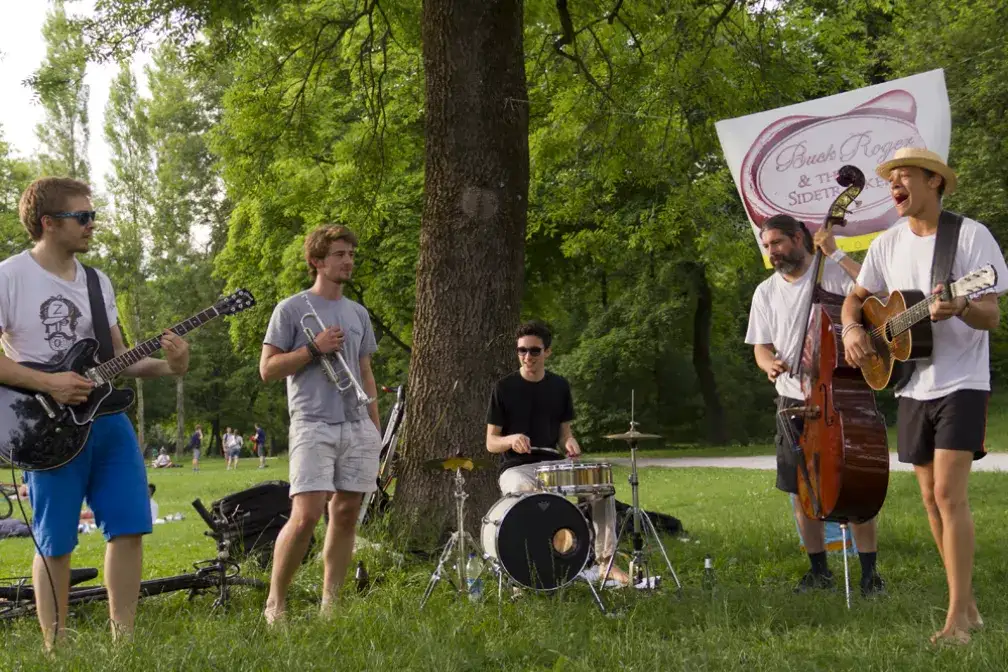
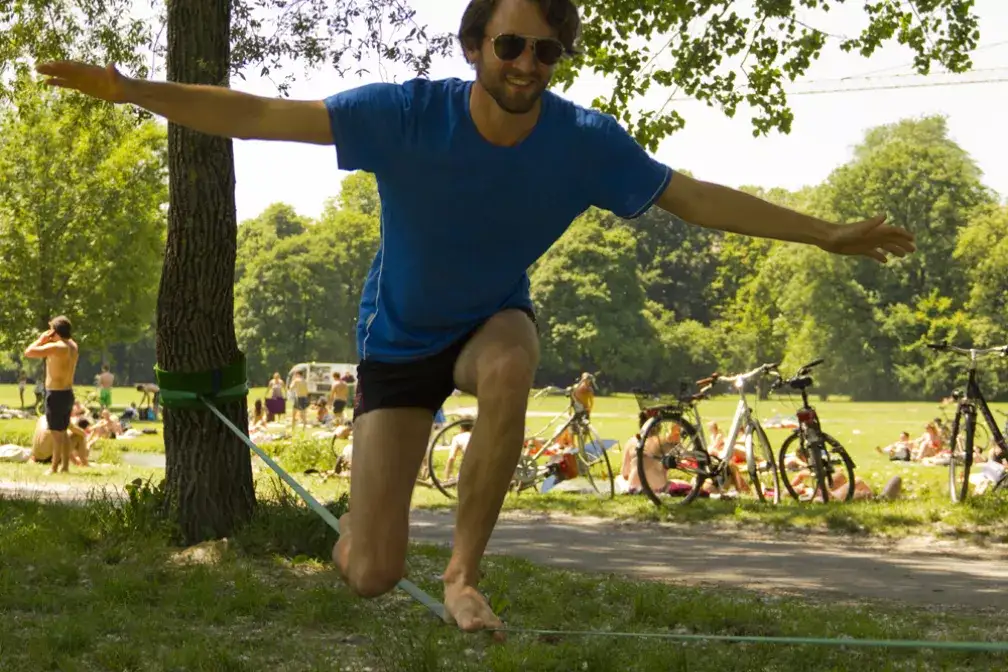
- El Jardín Inglés es un sueño para todos los deportistas: ciclistas y corredores entrenan en 78 kilómetros de senderos. En primavera, verano y otoño, los equilibristas estiran sus slacklines entre los árboles, los jugadores de frisbee lanzan sus discos y los futbolistas aficionados se reúnen para jugar al fútbol.
- No es necesario ser un profesional, pero sí un experto si uno quiere subirse a una tabla de surf en Eisbach, en el extremo sur. Allí los surfistas muestran sus trucos en el agua fría en cualquier época del año, ante la mirada de muchos espectadores.
- A veces el ambiente es animado y otras veces relajado en el Kleinhesseloher See, en el límite con el norte del Jardín Inglés. El lago no es apto para nadar, pero se puede pasar un día perfecto en el agua remando o en barca a pedales. No sólo en verano cientos de personas se sientan en la orilla.
- En la parte norte del parque se encuentran grupos haciendo yoga o Thai Chi. Todos los amantes de los caballos también estarán contentos, porque además de una selección de rutas aquí se encuentra la Escuela Universitaria de Equitación.
Está prohibido bañarse en Eisbach y Floßlände
El surf en Eisbachwelle, cerca del museo Haus der Kunst, se legalizó en el verano de 2010. Sin embargo, este permiso sólo se aplica a surfistas con experiencia; los atletas con menos experiencia pueden ponerse a prueba en el Floßlände. Surfear es bajo el propio riesgo.
No está permitido nadar ni bañarse en ningún lugar del Eisbach ni en el Floßlände.
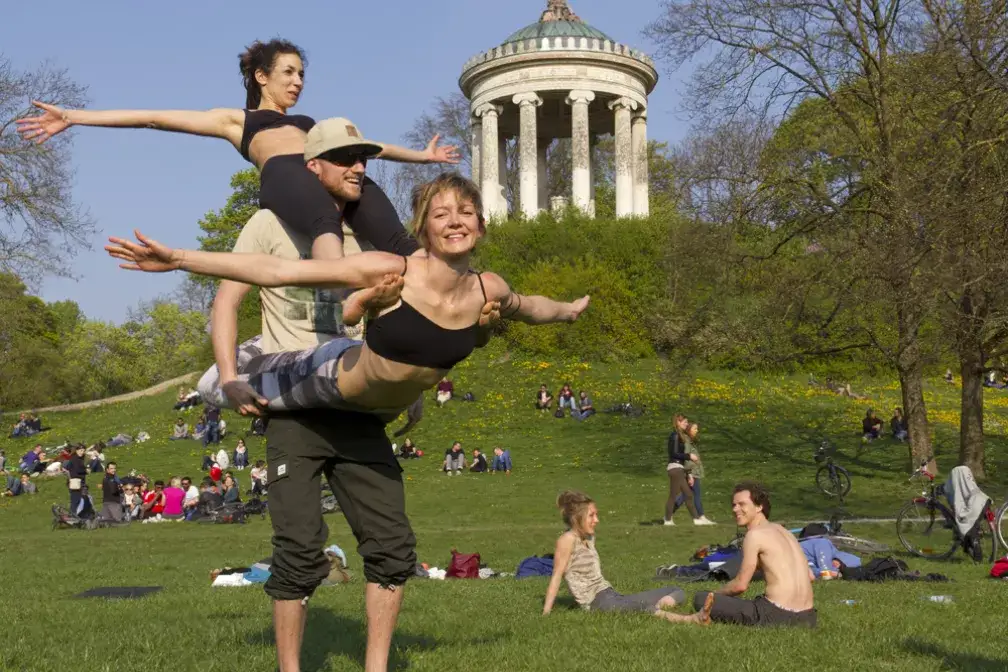
Eventos: Festival de Japón, Kocherlball y mercado navideño
- Un evento destacado es el Kocherlball en la Torre China, que se celebra una vez al año, normalmente un domingo de verano en julio, entre las 6 y las 10 de la mañana. El baile de disfraces se remonta a una tradición de las empleadas domésticas de Múnich que se reunían antes del trabajo para bailar.
- Los fines de semana de verano, los actores aficionados representan regularmente obras al aire libre en el Jardín Inglés del norte. Los espectadores también llevan picnics y linternas al anfiteatro cerca de la ciudad estudiantil.
- En la casa de té japonesa de la parte sur se celebran regularmente ceremonias tradicionales del té y el tercer domingo de julio se celebra el "Festival de Japón" alrededor de la casa de té.
Guided Tours and Horse-Drawn Carriage Rides Through the English Garden
Those who want to delve deeper into history, landscape architecture, and nature can take part in themed tours or book guided tours for private groups. The Palace Administration provides specific information on these options. Guided tours are particularly fascinating for anyone who wants to understand the English Garden not just as a recreational space, but as a carefully designed landscape park.
👉 Guided tours reveal just how much planning goes into the park’s seemingly natural landscape.
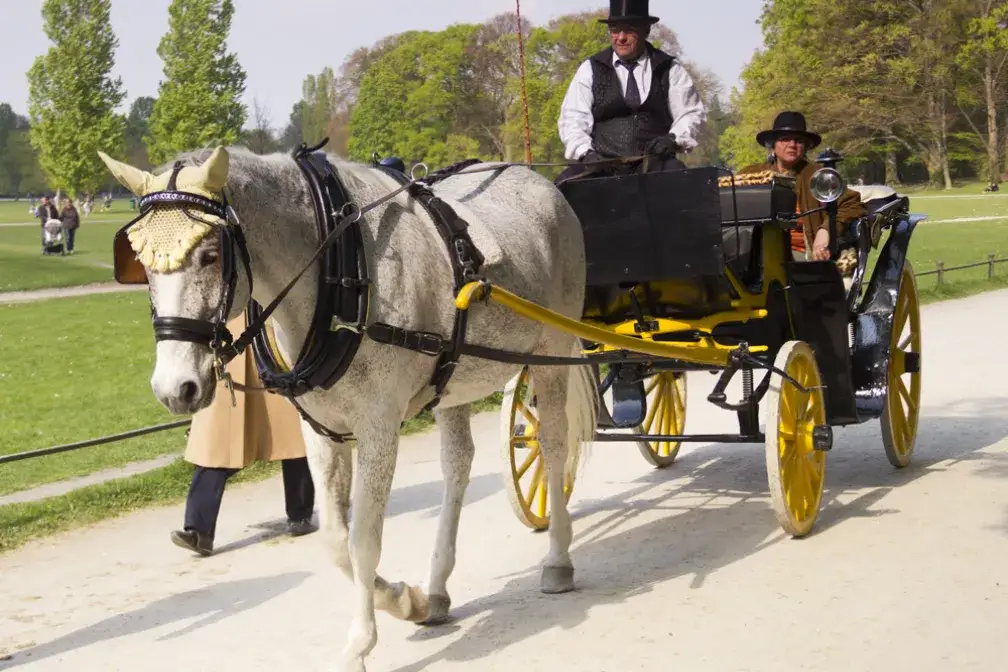
Those who want to experience the English Garden at a leisurely pace can also explore it by horse-drawn carriage. A carriage service offers rides through the English Garden. This is especially well-suited for visitors seeking a classic, more tranquil perspective on the park—passing by meadows, paths, old trees, and famous landmarks.
👉 Carriage rides showcase the English Garden from its classic, unhurried side.
Eating, Drinking, and Breaks
There are several classic places to stop for refreshments in the English Garden. Particularly well-known are the beer garden at the Chinese Tower and the Seehaus on Kleinhesseloher Lake. In the northern section, Hirschau and Aumeister are great spots for a break. There’s also the Minihofbräuhaus, MilchHäusl, and other kiosks like the Tivoli Pavilion.
- For your first visit: Chinese Tower
- For a view of the water: Seehaus on Kleinhesseloher Lake
- For the northern section: Hirschau or Aumeister
- For families: Chinese Tower, Seehaus
- For a quick stop: MilchHäusl near Königinstraße (near the university)
👉 Head to the Chinese Tower for a beer garden atmosphere, or to the Seehaus for a view of the water.
Parte Sur y Norte: ¿Cuál es la diferencia?
El parque se divide en una animada parte sur y una parte norte bastante tranquila. La parte sur es el área desde Prinzregentenstraße hasta Mittlerer Ring.
Si desea disfrutar de paz y tranquilidad mientras camina, hace jogging o monta en bicicleta, normalmente se encontrará en la parte norte, desde Mittlerer Ring hasta Freimann. Aquí experimentará el parque con sus prados salvajes nada agitados y, algunos días, incluso invadidos por un rebaño de ovejas.
Por cierto: el 28 de junio de 2017, la asamblea general del ayuntamiento decidió iniciar la planificación concreta de un túnel de 390 metros de longitud bajo Isarring. La calle que separa el Jardín Inglés en dos partes debería desaparecer bajo tierra.
Tips for Your Visit to the English Garden
- For a quick visit: Combine the Eisbach Wave, waterfalls, Japanese Tea House, Monopteros, and Chinese Tower.
- For peace and quiet: Head toward Hirschau, Schwammerlweiher, Aumeister, and Studentenstadt.
- For families: Plan to visit the meadows, children’s carousel, boating, Seehaus, and Rumfordschlössl.
- For nature: Discover flowering meadows, the wild bee nature trail, sheep, and waterfowl in the northern part.
- For culture: Combine the Japanese Tea House, Kocherlball, Christmas market, amphitheater, and themed tours.
- For dogs: Dogs are allowed in the park but must be kept on a leash.
👉 Your tour depends on whether you're looking for classic sights, tranquility, nature, culture, or a beer garden.
Directions: How to Get to the English Garden
The English Garden is large—so the best way to get there depends on which part you want to visit.
- Southern Entrance / Eisbach Wave / Haus der Kunst: Take bus 100 to Nationalmuseum/Haus der Kunst or Königinstraße; from there, you can quickly walk to the Eisbach Wave, waterfalls, Japanese Tea House, and southern meadows.
- Monopteros and Schönfeldwiese: Take the U3 or U6 to Universität or Giselastraße, then walk into the park.
- Chinese Tower, Rumfordschlössl, and children’s carousel: Take the bus to Chinesischer Turm; alternatively, walk from Giselastraße or Universität.
- Kleinhesseloher See and Seehaus: Take the tram to Tivolistraße or walk from the Chinese Tower toward the lake.
- Northern section, Wild Bee Nature Trail, Schwammerlweiher, and Aumeister: Take the subway to Studentenstadt as a good starting point.
- Parking: The most stress-free way to get there is by public transit or bike. Parking spaces on the outskirts are limited depending on the area.
👉 For your first visit, the southern entrance around the Haus der Kunst, Eisbach, and Monopteros is the most convenient.
Historia del Jardín Inglés
A lo largo de dos siglos, el Jardín Inglés fue cambiando constantemente, se añadieron constantemente nuevos edificios y zonas verdes, como por ejemplo el Hirschau o el antiguo jardín militar.
Todo empezó en 1789, cuando el elector Karl Theodor encargó la creación de un parque público en el Isar. Se suponía que debía ofrecer descanso al ejército, pero en 1792 se inauguró como parque público para unos 40.000 habitantes de Múnich.
Benjamin Thompson, que vino de América y luego se convirtió en el conde imperial von Rumford, y el jardinero de la corte de Schwetzingen, Friedrich Ludwig von Sckell, fueron los responsables del diseño original del parque.
El parque recibió el nombre de "Jardín Inglés" porque no estaba diseñado como un jardín barroco francés meticulosamente geométrico, sino al estilo de un parque paisajístico inglés.
La administración del Jardín Inglés es responsabilidad de la Administración Bávara de Palacios, Jardines y Lagos Estatales.
Accessibility and Restrooms
Many paths in the English Garden are flat and paved, and there are also numerous places to sit. The path to the Monopteros is not accessible because it has a slope of more than six percent. Accessible restrooms are available at the restaurants and beer gardens Seehaus, Hirschau, Chinesischer Turm, and Aumeister, as well as at the Tivoli Pavilion.
👉 Many paths are easily accessible—only the Monopteros is difficult for wheelchairs and strollers.
By the Numbers
- 376 hectares of parkland; 411 hectares including adjacent areas
- 187 hectares of meadows, 170 hectares of woodlands, 16 hectares of water bodies
- 78 kilometers of trails, including about 12 kilometers of horseback riding trails
- 15 kilometers of streams and over 100 bridges and footbridges
- 8 hectares of Kleinhesseloher Lake
- 50 to 60 species of breeding birds
- more than 5 million visitors per year
- 7,000 seats in the beer garden at the Chinese Tower
👉 These figures show why the English Garden is more than just a city park.
Good to Know: Rules in the English Garden
The English Garden is a park, a historic garden, and a protected landscape area. To ensure it remains that way, clear rules apply: Barbecues, open fires, and camping are prohibited. Swimming in the water is life-threatening and not allowed. Dogs must be kept on a leash, trash must be disposed of in the bins, and visitors should avoid walking on the lawns and in the wooded areas unless necessary.
This is more than just a formality: Every year, around 120 metric tons of trash must be collected and disposed of in the English Garden. The largest portion of this comes from littering on the lawns during weekends.
👉 The English Garden is open to everyone—and it stays beautiful when everyone is considerate.
FAQ
When is the English Garden open and how much is admission?
The English Garden is open all year round. Admission is free.
Which sights should you see in the English Garden?
For a first visit, the Eisbach wave, Japanese Tea House, Monopteros, Chinese Tower, Rumford House and Kleinhesseloher Lake are particularly recommended. These attractions are located in the southern section or around the transition towards Schwabing and can easily be combined on a walk.
Which meadows are there in the English Garden?
Well-known meadows include Schönfeldwiese in the southern section, Werneckwiese near Kleinhesseloher Lake, Schwabinger Bucht and the extensive meadows of the Hirschau in the northern section. New wildflower meadows have recently been created on Schönfeldwiese and Werneckwiese.
Can you go boating on Kleinhesseloher Lake?
Yes, pedal boats and rowing boats are available on Kleinhesseloher Lake. The boat rental is located on the northern shore near the Seehaus. Swimming in Kleinhesseloher Lake is not permitted.
Can you see chicks in the English Garden?
In spring, waterbirds with their young can often be seen at Kleinhesseloher Lake and along quieter sections of the shore. Please keep your distance and do not feed the animals.
How much time do you need for the English Garden?
Around 1 to 1.5 hours is enough for a short walk through the southern section. Visitors who want to continue to Kleinhesseloher Lake or explore the quieter northern section should allow 2 to 3 hours.
Is the English Garden accessible?
Many paths are level and paved. However, the path to the Monopteros is not accessible because it has a gradient of more than six per cent. Accessible toilets are available at several locations, including the Seehaus, Hirschau, Chinese Tower, Aumeister and Tivoli Pavilion.
Are you allowed to swim in the English Garden?
No. Swimming in the waters of the English Garden is prohibited and can be life-threatening.
Are you allowed to barbecue in the English Garden?
No. Barbecuing, open fires and camping are prohibited in the English Garden.
Are dogs allowed in the English Garden?
Yes, dogs are allowed. However, they must be kept on a lead in the park, and dog waste must be removed.
Can you go horse riding in the English Garden?
Yes, there are around 12 kilometres of bridleways, a riding meadow and a show-jumping meadow. Riders require a paid annual riding permit. Day passes are not available.
Are carriage rides available in the English Garden?
Yes, carriage rides through the English Garden are available. The Bavarian Palace Administration lists them as a service for visitors.
Where is it quieter in the English Garden?
The northern section towards the Hirschau, Aumeister and Studentenstadt is generally quieter. The southern section around the Eisbach wave, Monopteros and Chinese Tower is considerably busier, especially in fine weather and at weekends.
Which beer gardens are there in the English Garden?
Popular places to eat and drink include the Chinese Tower, Seehaus, Hirschau and Aumeister. The beer garden at the Chinese Tower has around 7,000 seats.
Which events take place in the English Garden?
Popular events include the Kocherlball at the Chinese Tower, the Japan Festival at the Japanese Tea House, open-air theatre performances in the amphitheatre and the Christmas market at the Chinese Tower. Dates may change, so it is advisable to check the events calendar before visiting.
En un vistazo
Englischer Garten - El Jardín Inglés de Múnich
Englischer Garten
80538
München
Acceso sin barreras
Acceso sin barreras en el edificio