
The historic bronze figure offers the best view of the Theresienwiese
Bavaria statue and Hall of Fame
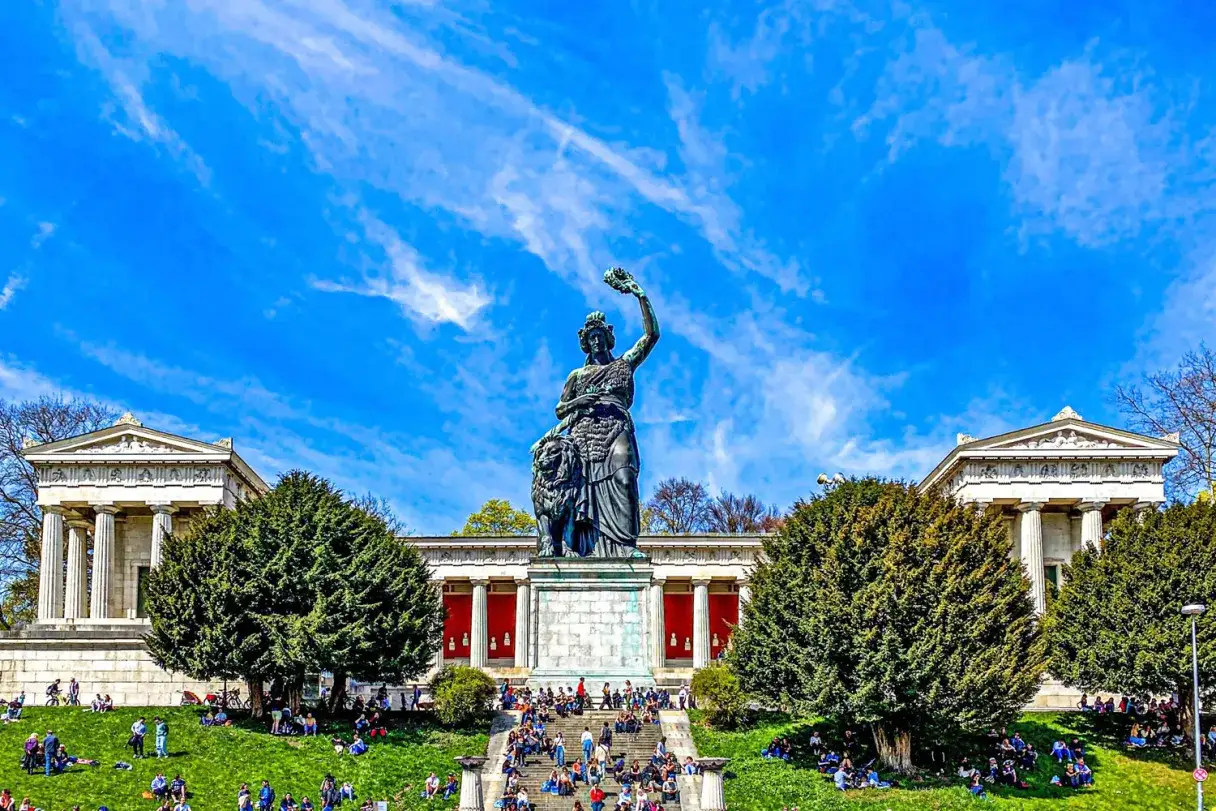
Since 1850, the Bavaria statue has gazed confidently out over the Theresienwiese. This monumental bronze statue is one of Munich’s landmarks and offers a unique vantage point—and not just during Oktoberfest. Behind it, the Hall of Fame (Ruhmeshalle), featuring the busts of notable figures, commemorates Bavarian history.
More actions
The Bavaria at a glance
- Where? Theresienhöhe 16 in the Schwanthalerhöhe district, on the western edge of the Theresienwiese
- What? An 18.52-meter-tall bronze statue that can be entered, featuring an observation platform, plus a three-winged Hall of Fame containing 98 busts
- 2026 Opening Hours: March 28 to October 19, daily from 9 a.m. to 6 p.m.; last admission at 5:30 p.m.
- Admission: €5 (reduced: €4); free for those under 18
- Getting there: U4/U5 subway lines to Theresienwiese or Schwanthalerhöhe; bus to Theresienhöhe
- Accessibility: The observation platform is accessible only via a steep, narrow spiral staircase
- Good to know: During Oktoberfest, the Bavaria statue is open until 8 p.m.; the Hall of Fame remains closed
The Bavaria: Who is the bronze lady?

Bavaria is a sought-after figure—and has been for centuries. Today, she adorns postcards and souvenirs and is one of Munich’s most famous photo subjects. At the same time, she embodies the state of Bavaria and is regarded as its secular patroness.
Ludwig Schwanthaler gave this imposing female figure a long, simple gown and a bearskin. She holds an oak wreath aloft in one hand and a sword in the other. Beside her sits a lion—the heraldic animal of Bavaria. Through these features, the sculptor consciously broke away from classical models and imbued the figure with ancient Germanic characteristics.
King Ludwig I commissioned the monumental statue in 1837. Together with the Hall of Fame (*Ruhmeshalle*), it was intended to commemorate Bavaria’s achievements and renown. Ludwig Schwanthaler designed the figure, while Ferdinand von Miller completed the casting of the bronze—weighing 1,560 hundredweight—in 1850; it was a technical masterpiece of the 19th century.
From her feet to the raised oak wreath, Bavaria measures 18.52 meters. Add to this the 8.92-meter-high pedestal, and Munich’s "biggest lass" is visible from afar, towering over the Theresienwiese.
👉 The Bavaria statue at Munich’s Theresienwiese combines an oak wreath, a sword, a bearskin, and the Bavarian lion into a monumental personification of Bavaria.


Viewing platform in the Bavaria's head

Something even some locals don’t know: you can actually take a look inside the statue. A spiral staircase leads all the way up to the head of the Bavaria. Through four viewing ports, you can look out over the Theresienwiese and the Munich skyline.
The final steps leading to the head are very narrow. On sunny days, the bronze can heat up significantly. The climb is not suitable for people with limited mobility.
In general, the Bavaria is a great spot to photograph the *Wiesn* and get an overview of the lively bustle below. However, you will need some patience: the viewing platform is particularly popular during Oktoberfest.
👉 From the head of the Bavaria, the view stretches across the Theresienwiese all the way to Munich’s city center.
The Hall of Fame

The three-winged Hall of Fame (*Ruhmeshalle*) extends behind the Bavaria statue. Leo von Klenze designed this Neoclassical colonnaded hall, modeling it after colossal altars of antiquity. King Ludwig I commissioned its construction between 1843 and 1853 as a temple of honor for individuals who had made significant contributions to Bavaria, science, or the arts.
Today, the hall houses 98 busts. Those honored include the painter Albrecht Dürer, the writer Ludwig Thoma, the composer Carl Orff, and the brewer Joseph Pschorr. Women inducted to date include the writer Lena Christ, the actress Clara Ziegler, the explorer Therese of Bavaria, and the mathematician Emmy Noether.
The Hall of Fame was severely damaged during World War II. Reconstruction took place between 1965 and 1972. Since 1966, the Free State of Bavaria has continued the tradition by inducting further notable figures into the Hall of Fame.
👉 Situated above Munich’s Theresienwiese, the Hall of Fame houses 98 busts of significant figures from Bavarian history.
Munich's most famous meadow: The Theresienwiese

There is something going on at the foot of the Bavaria statue almost all year round. Whether it is Oktoberfest, a giant flea market, the Spring Festival, or the Winter Tollwood festival, the Theresienwiese is one of Munich's most important event venues.
It is best known for
- Oktoberfest, which begins in mid- or late September and lasts for a good two weeks.
- The Spring Festival takes place in late April and early May.
- The Tollwood Winter Festival is held during the winter months.
- The Central Agricultural Festival is scheduled to take place every four years; following its cancellation for 2024, the next event is planned for 2028.
👉 The Theresienwiese, located beneath the Bavaria statue, is not just the site of Oktoberfest but serves as a central event venue for Munich throughout the year.
Insider tips: Events and leisure at the Bavaria

- During the roughly twelve-week setup period for Oktoberfest, watch the festival tents and rides take shape on the Theresienwiese from the head of the Bavaria statue.
- Join the fun: On the second Sunday of the festival, the bands from the large tents gather on the steps of the Bavaria for an open-air concert.
- New Year's Eve at the Bavaria: The Theresienwiese and the steps of the Bavaria offer a great view of the fireworks over Munich.
👉 The Bavaria is not just a vantage point; it is also a unique venue for events and seasonal experiences on Munich’s Theresienwiese.
Bavariapark

Bavariapark begins behind the Bavaria statue and the Hall of Fame. Do you enjoy going for walks and having some peace and quiet? Then this is the place for you. Families, walkers, and joggers, in particular, make use of the paths and lawns in this relatively quiet neighborhood park.
Several sculptures dating from the 19th and early 20th centuries stand amidst the mature trees. The Deutsches Museum’s Transport Centre is also located right next to the park.
👉 Bavariapark, situated behind the Hall of Fame, is a peaceful green space in Munich’s Schwanthalerhöhe district.
Winter fun at the Bavaria
In winter, the slopes in front of the Hall of Fame turn into a sledding hill. Short, relatively gentle runs are suitable for younger children, while a steeper slope nearby caters to more experienced sledders. Straw bales are used to secure obstacles, though sledding is still at your own risk.
👉 When there is sufficient snow, both gentle sledding slopes and a steeper run can be found in front of the Bavaria statue at Munich’s Theresienwiese.
Directions to the Bavaria and the Hall of Fame
You can reach the Bavaria statue by subway via the Theresienwiese or Schwanthalerhöhe stations, served by lines U4 and U5. It is just a short walk from there. The Theresienhöhe bus stop is also nearby.
A large flight of outdoor steps leads up from the western edge of the Theresienwiese to the statue and the Hall of Fame.
FAQ: Frequently Asked Questions about the Bavaria and the Hall of Fame
Can you go inside the Bavaria statue?
Yes. During the season, a narrow spiral staircase leads through the interior of the statue up to the viewing platform in the head.
How many steps lead up to the head of the Bavaria?
Inside, there are 126 steps leading to the viewing platform. Before that, you ascend the large outdoor staircase—consisting of 48 steps—to reach the statue.
How much does admission to the Bavaria cost?
In 2026, the regular admission fee is 5 euros, with a reduced rate of 4 euros. Admission is free for children and young people under the age of 18.
When are the Bavaria statue and the Hall of Fame (Ruhmeshalle) open?
From March 28 to October 19, 2026, they are open daily from 9:00 a.m. to 6:00 p.m. Last admission is at 5:30 p.m. They are closed for the winter break from October 20, 2026, to March 19, 2027.
Is the Bavaria accessible to people with disabilities?
No. The viewing platform can only be reached via a steep, narrow staircase.
Is the Bavaria open during Oktoberfest?
Yes. During Oktoberfest, the Bavaria remains open until 8:00 p.m., with last admission at 7:30 p.m. The Hall of Fame remains closed during this time for safety reasons.
What can you see from the head of the Bavaria?
Through four small openings, you can look out over the Theresienwiese and towards Munich's city center. During Oktoberfest, you can see the festival tents, rides, and the fairgrounds from there.
How many people fit on the viewing platform?
There are two small benches inside the head of the Bavaria with space for a total of six people. Consequently, waiting times may occur when it is busy.
How do I get to the Bavaria using public transport?
The nearest U-Bahn (subway) stations are Theresienwiese and Schwanthalerhöhe, served by lines U4 and U5. The Theresienhöhe bus stop is also nearby.
Can you go sledding at the Bavaria?
Yes. When there is sufficient snow, the slopes in front of the Hall of Fame are suitable for sledding. Use is at your own risk.


At a glance
Bavaria statue and hall of fame at Theresienwiese
Theresienhöhe 16
80339
München
Tel:
+4989290671
