
Munich's central square with the New Town Hall and the Glockenspiel
Marienplatz in Munich's Old Town
Marienplatz is Munich’s central square and one of the best starting points for exploring the Old Town. It is home to the New Town Hall with its famous Glockenspiel, the Old Town Hall, the Mariensäule (Column of St. Mary), and the Fish Fountain. You can reach the Frauenkirche, Alter Peter, Viktualienmarkt, and Kaufingerstraße on foot in just a few minutes.
Whether for sightseeing, taking photos, strolling through the city, attending events, or simply meeting up with others, Marienplatz offers a concentrated dose of the Munich experience. Particularly popular attractions include the Glockenspiel in the town hall tower, the views from Alter Peter or the town hall tower, and the routes through the pedestrian zone.

More actions
Marienplatz Munich: Key information at a glance
- Location: Old Town, Munich city center
- Address: Marienplatz 1, 80331 Munich
- Public transport: U-Bahn (subway) and S-Bahn (urban rail) to Marienplatz
- Sights: New Town Hall, Glockenspiel, Old Town Hall, Mariensäule (St. Mary's Column), and Fish Fountain
- Views: Town Hall tower and "Alter Peter" (St. Peter's Church) nearby
- Glockenspiel: Daily at 11 a.m. and 12 p.m.; additional performance at 5 p.m. from March to October; night performance at 9 p.m.
- Admission: Marienplatz is a public space and freely accessible
- Ideal for: Visiting the Old Town, sightseeing, strolling through the city, taking photos, and meeting up
- Nearby: Frauenkirche, Alter Peter, Viktualienmarkt, Kaufingerstraße, Tal, Hofbräuhaus, and the Residenz
- Services: M-WLAN (public Wi-Fi), muenchen.de webcam, and direct U-Bahn and S-Bahn connections
New Town Hall, Old Town Hall, and Glockenspiel at Marienplatz Open configuration settings
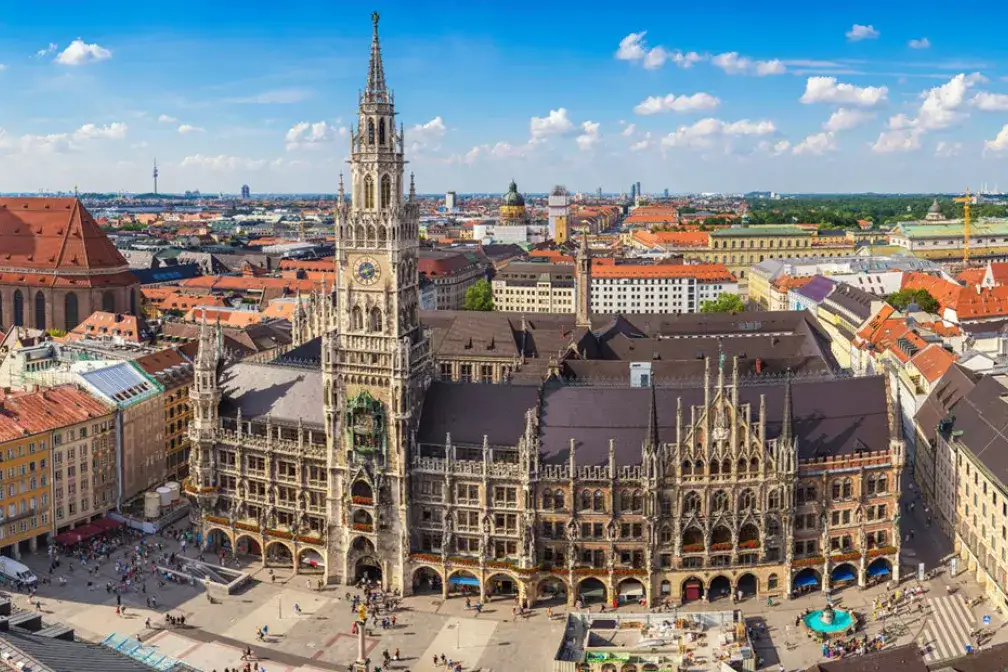
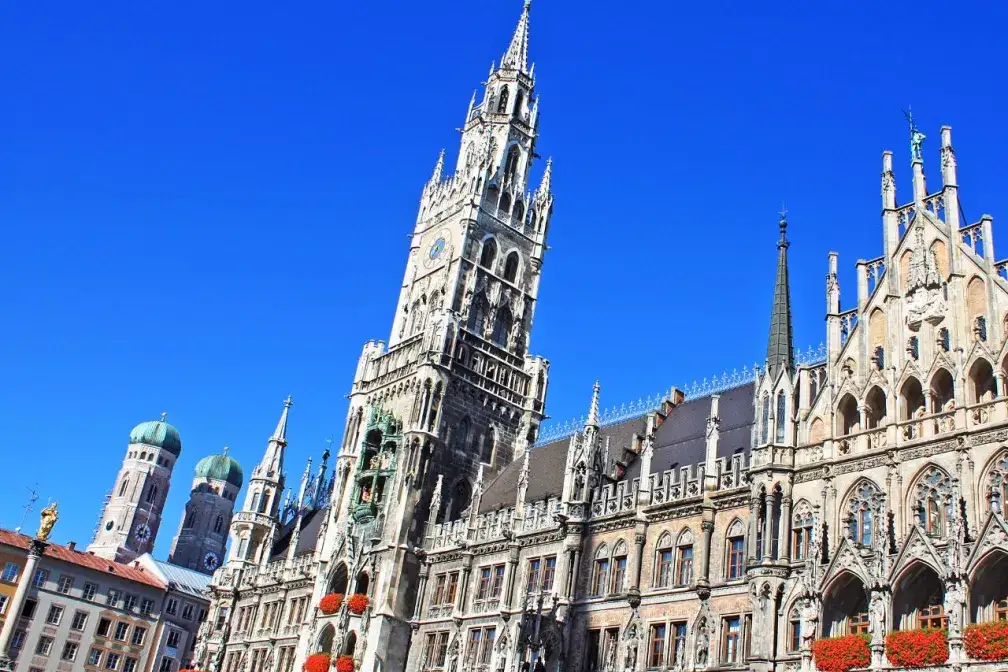
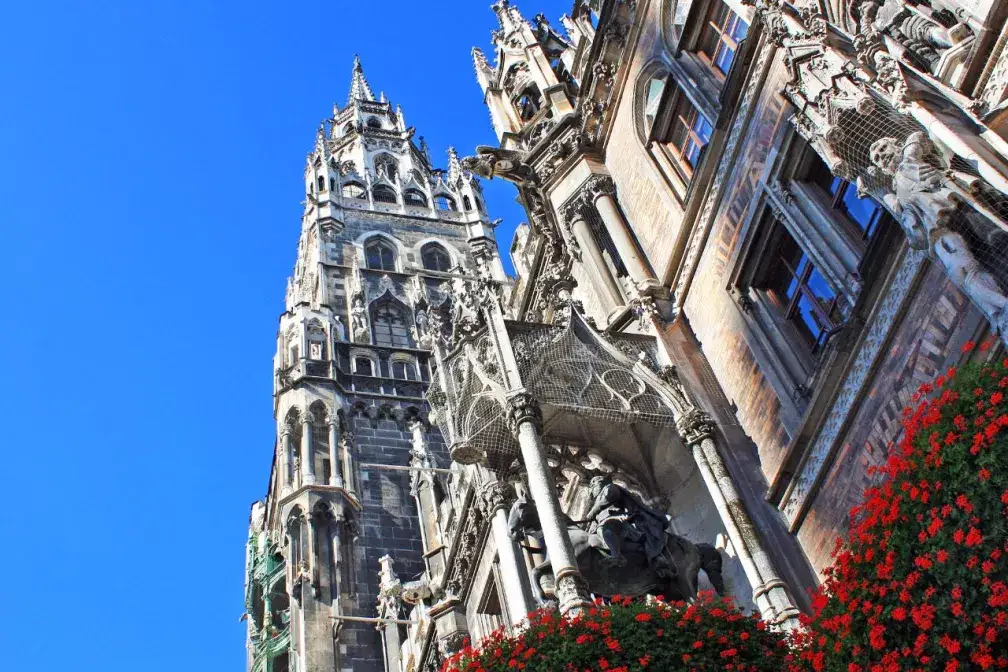
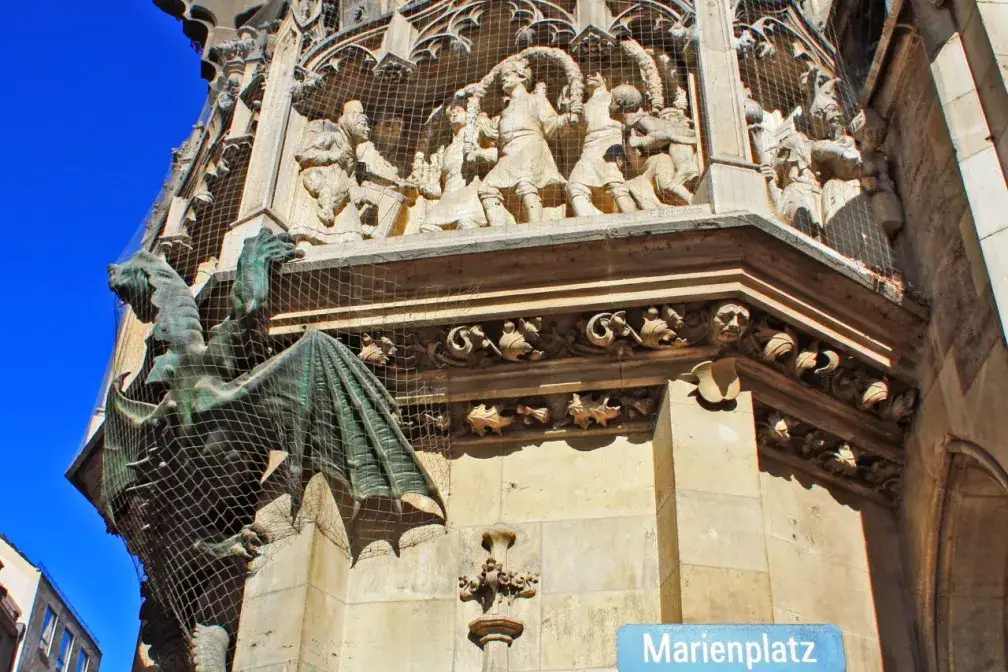
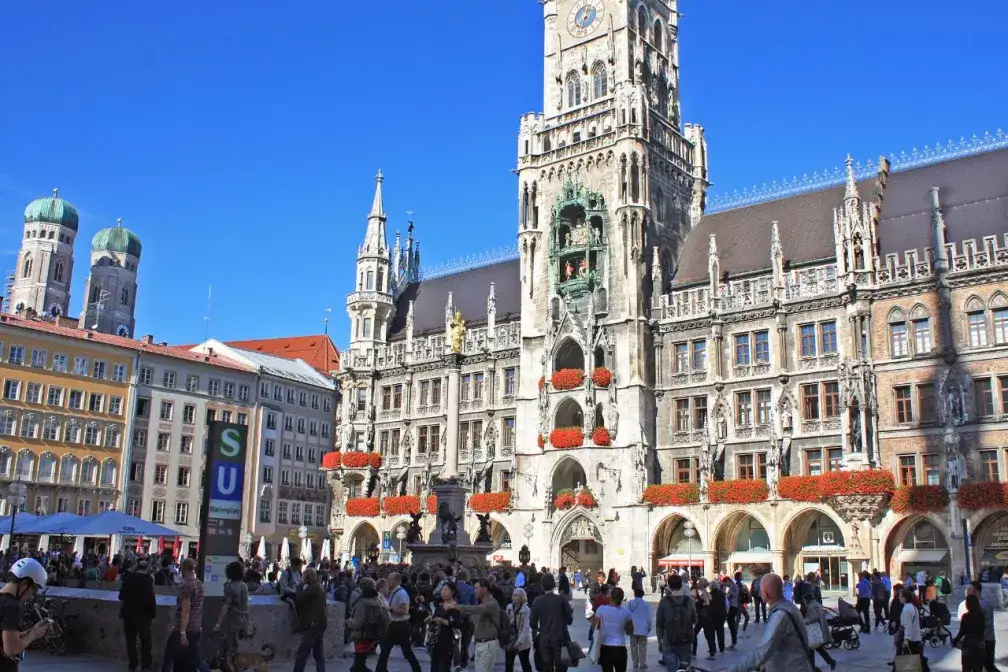
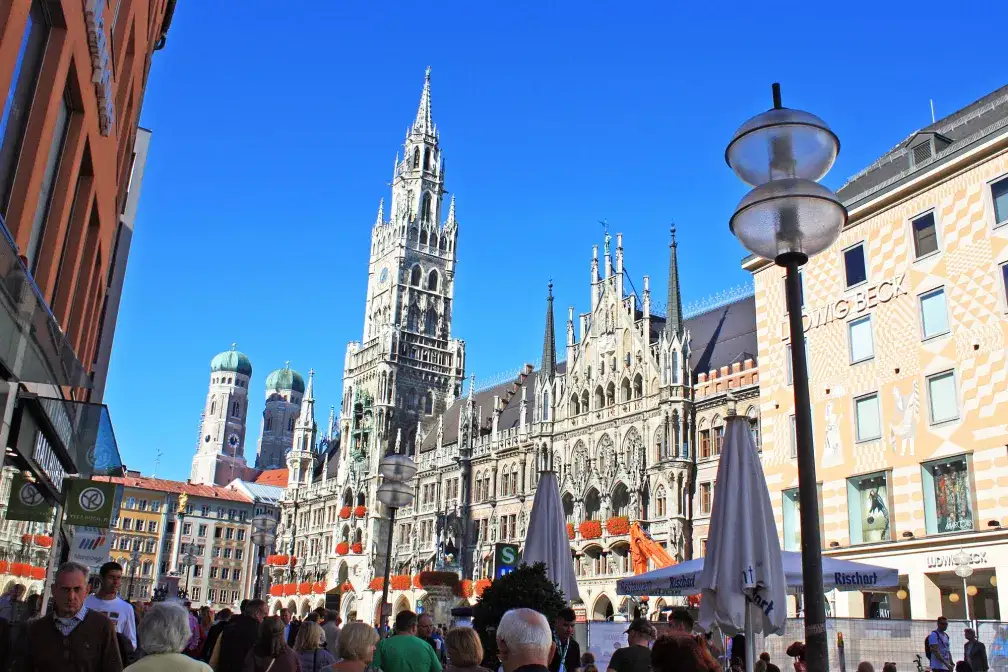
The New Town Hall defines the north side of Marienplatz. Although it appears older, it was actually built between 1867 and 1909 in the Neo-Gothic style by architect Georg von Hauberrisser (1841–1922). Since its completion, it has served as the seat of the Lord Mayor, the City Council, and the municipal administration.
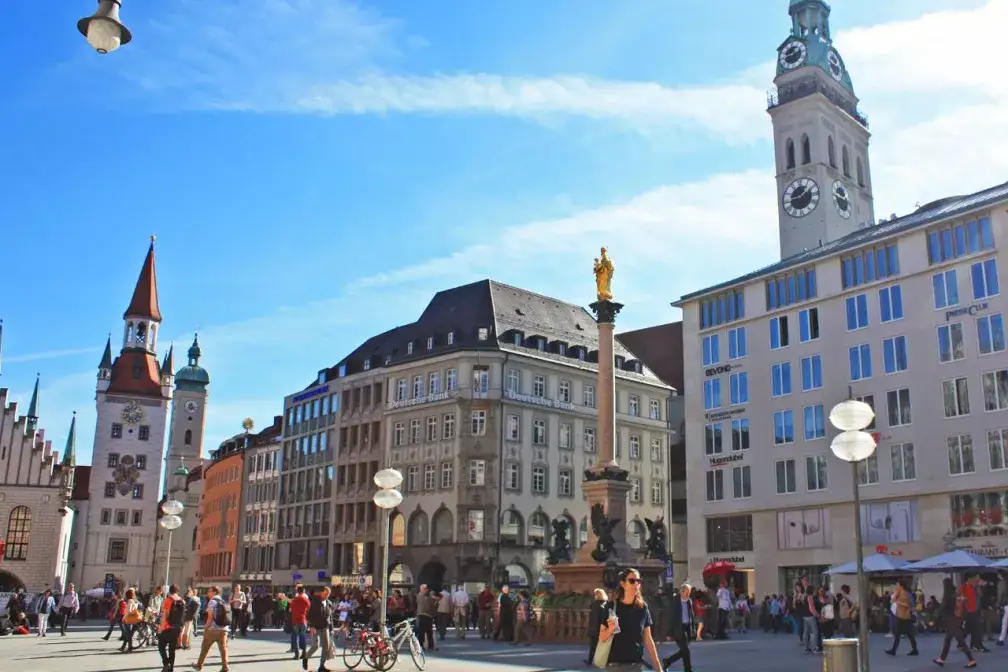
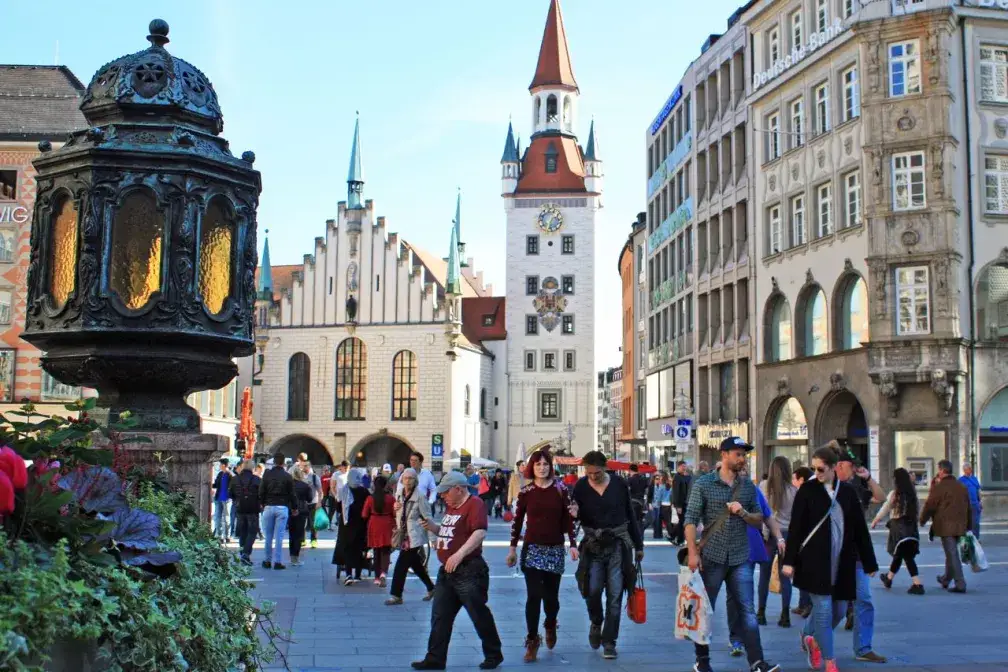
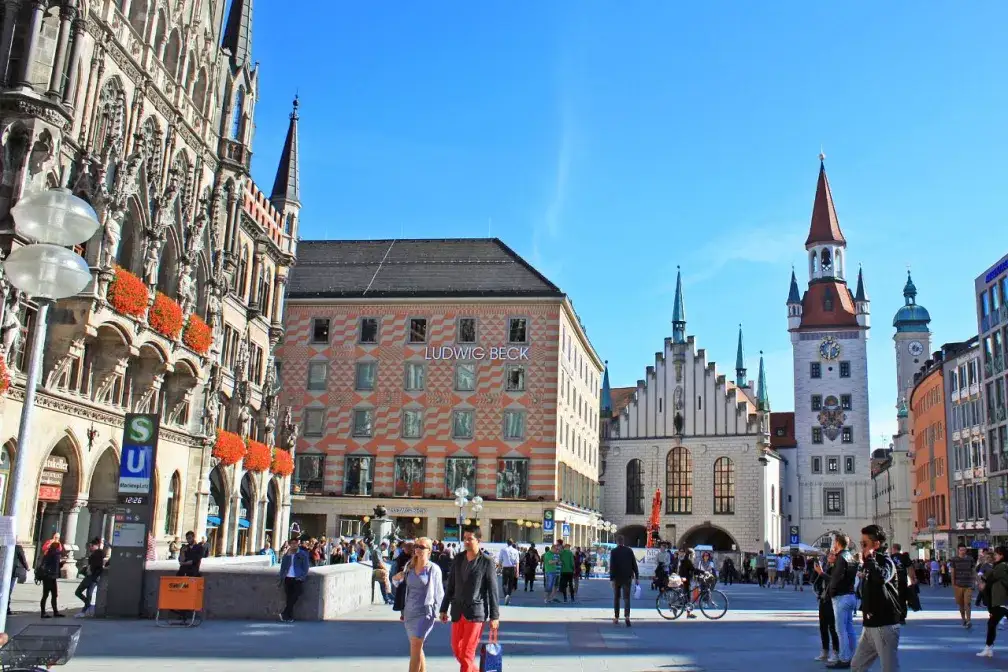
The Old Town Hall (1470–1475) bounds Marienplatz to the east, towards the Tal district, and is significantly older than the New Town Hall. Today, it is primarily used for ceremonial purposes; its Gothic ceremonial hall hosts events such as formal ceremonies, award presentations, and official functions.
The tower of the New Town Hall is doubly interesting: it features an observation deck at the top, while the famous Glockenspiel (carillon) plays just below. These features make the square one of Munich’s most popular photo spots and meeting points.
👉 The New Town Hall stands on the north side of Marienplatz, the Old Town Hall closes off the square towards the Tal district, and the Glockenspiel is located in the tower of the New Town Hall.
The Mariensäule: The monument in the middle of the Marienplatz

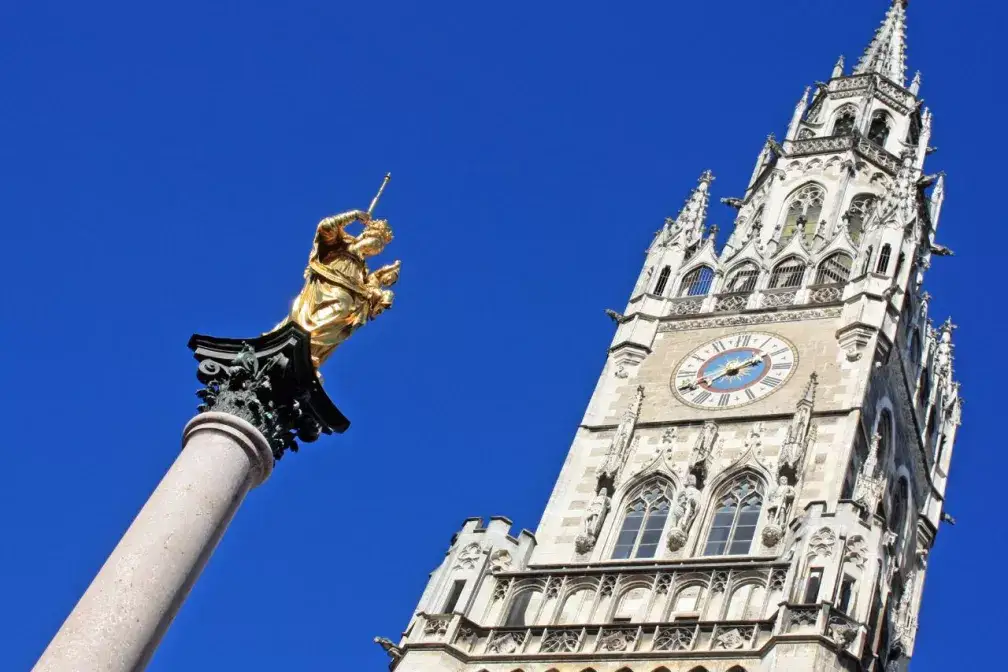
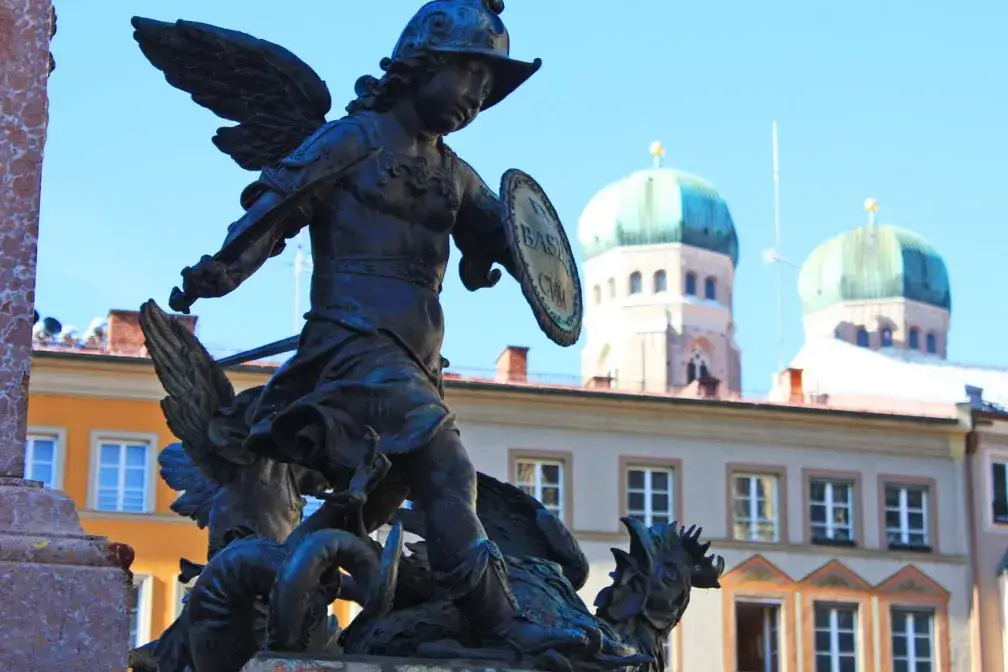
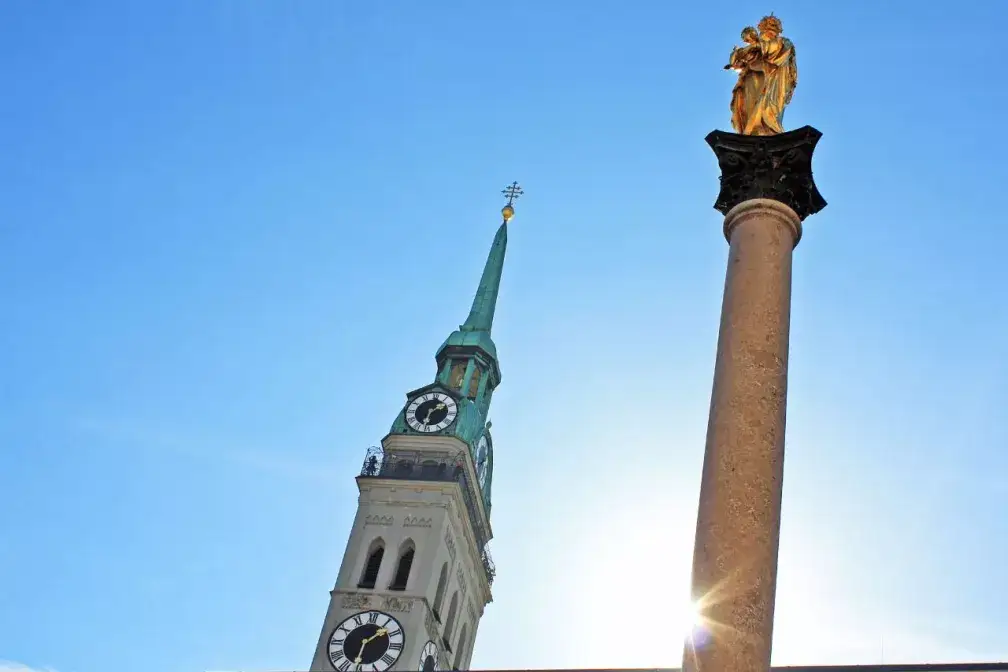
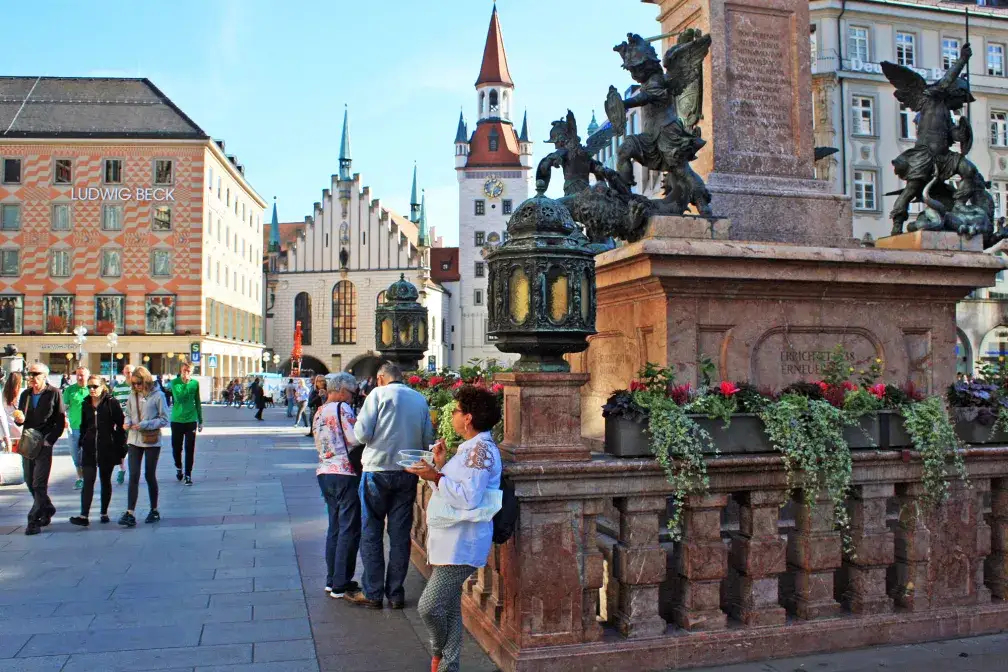
- Standing proudly in the center of Marienplatz is the Mariensäule (Column of St. Mary), dedicated to the Virgin Mary as the "Patroness of Bavaria." A statue of Mary—created by Hubert Gerhart around 1593—adorns the top of the column, which rises over eleven meters high.
- Depicted with a scepter and crown, holding the blessing Christ Child (who carries an orb) in her arms and standing upon a crescent moon, she symbolizes faith and hope.
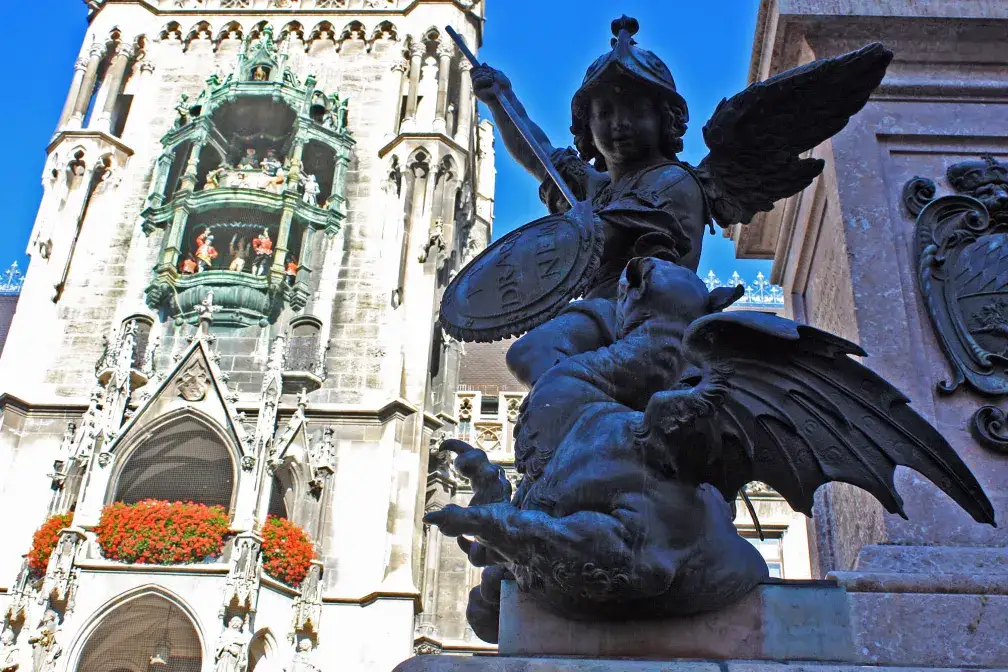
- The column's base commemorates the four plagues of that era: heresy (represented by a serpent), war (a lion), famine (a dragon), and the plague (a basilisk).
- Elector Maximilian commissioned this votive monument in 1638 out of gratitude for Munich having survived the Thirty Years' War (1618–1648). The column was consecrated on Marienplatz (then known as Schrannenplatz) on November 7, 1638—the eve of the anniversary of the Battle of White Mountain near Prague (November 8, 1620).
- Serving as a memorial and a monument of thanksgiving for the salvation of the land and the ruling dynasty, the Mariensäule remains a site for public worship and prayer to this day.
👉 The Mariensäule has stood on Marienplatz since 1638, commemorating the fact that Munich was spared during the Thirty Years' War.
Video: Marienplatz is so beautiful

Externer Beitrag
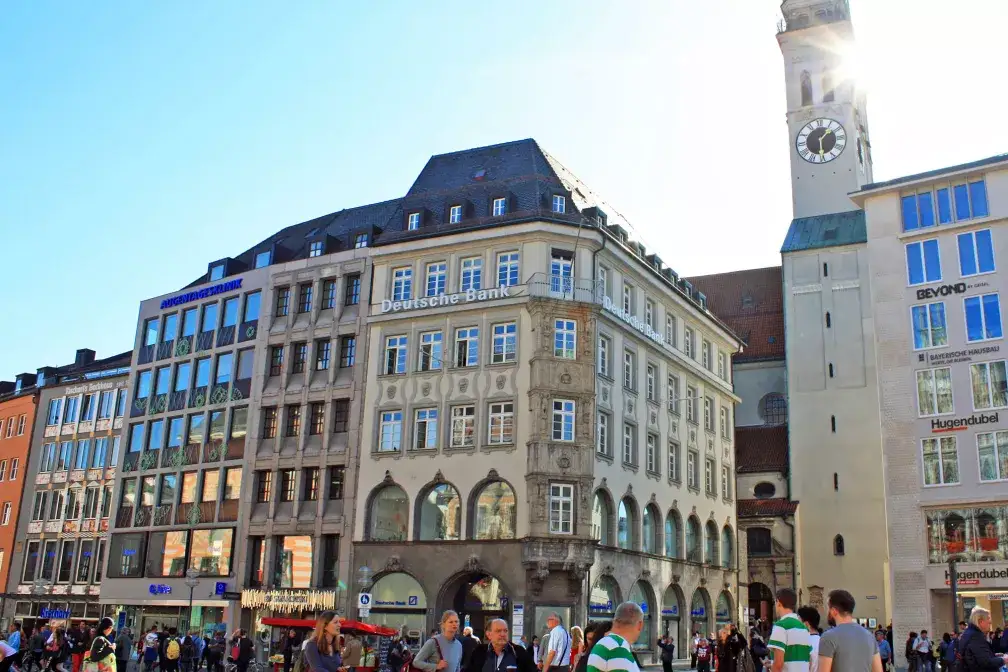
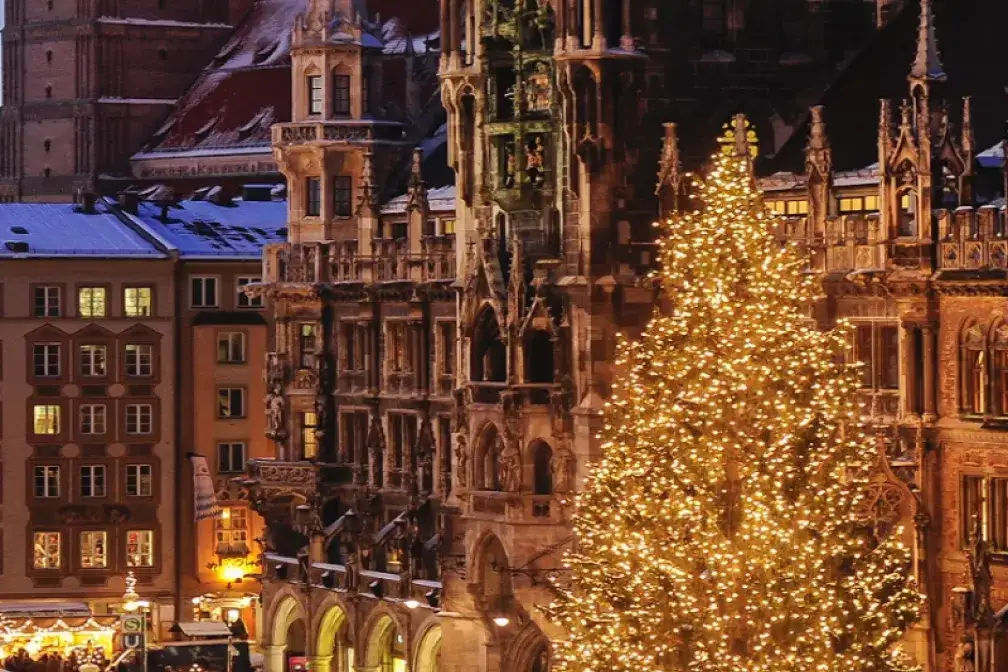
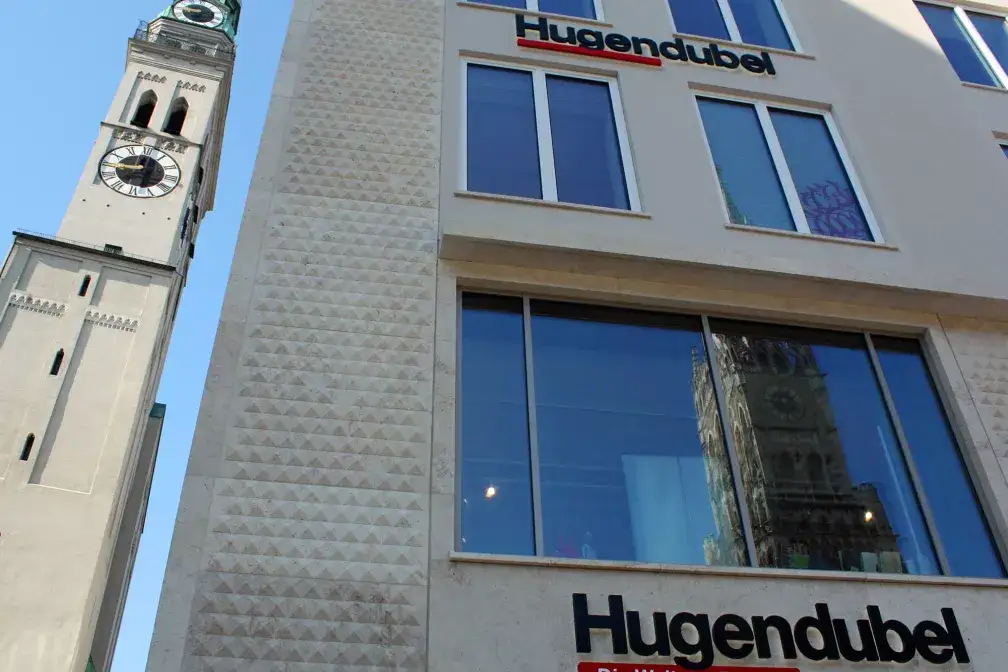
Pictures from the Marienplatz
Ad

The Glockenspiel: Chimes with a moving history of the city

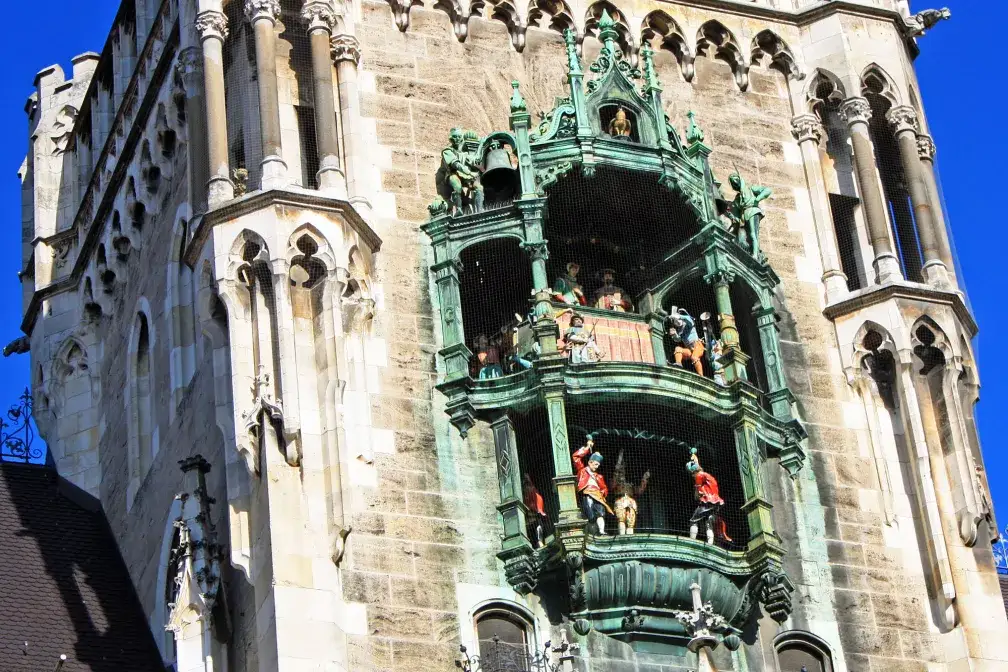
- The Glockenspiel in the New Town Hall is one of the most famous attractions on Marienplatz. It depicts two scenes from Munich's history: the wedding of Duke Wilhelm V to Renata of Lorraine in 1568 and the *Schäfflertanz* (Coopers' Dance).
- On the upper level, a knight's tournament commemorates the royal wedding. On the lower level, the coopers perform their dance; according to tradition, they helped restore the city's joie de vivre following a plague epidemic. The Glockenspiel features 43 bells and 16 figures and has been on display since 1908.
- It performs regularly every day at 11 a.m. and 12 p.m. From March to October, there is an additional performance at 5 p.m. At 9 p.m., the night performance takes place, featuring the night watchman, an angel, and the *Münchner Kindl* (Munich Child).
👉 The Glockenspiel on Marienplatz performs daily at 11 a.m. and 12 p.m., with an additional performance at 5 p.m. from March to October, and a night performance at 9 p.m.
Fish Fountain at Marienplatz: Meeting point in front of the New Town Hall

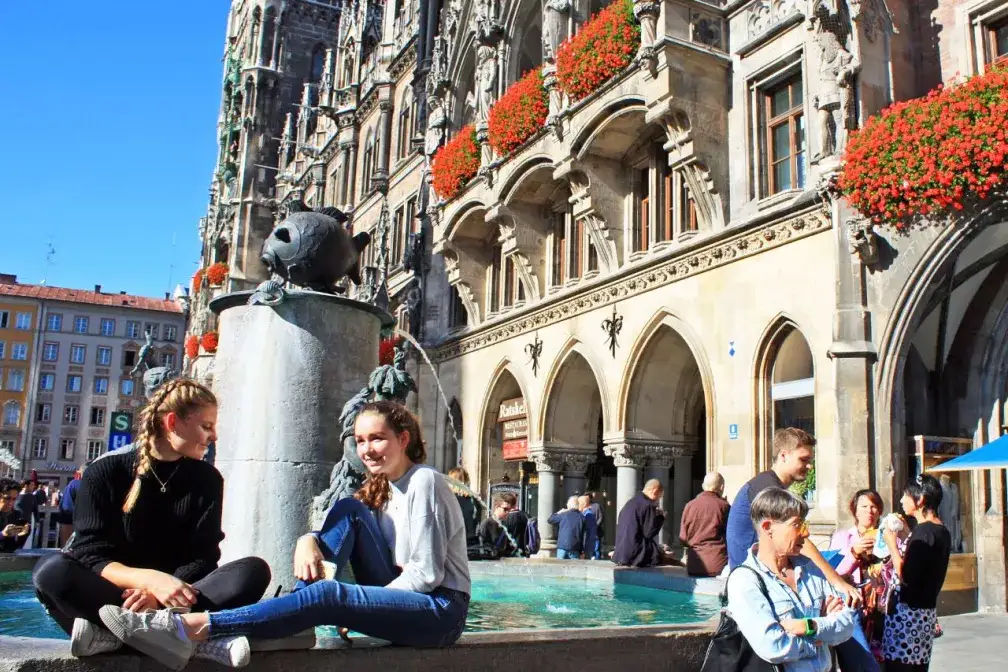
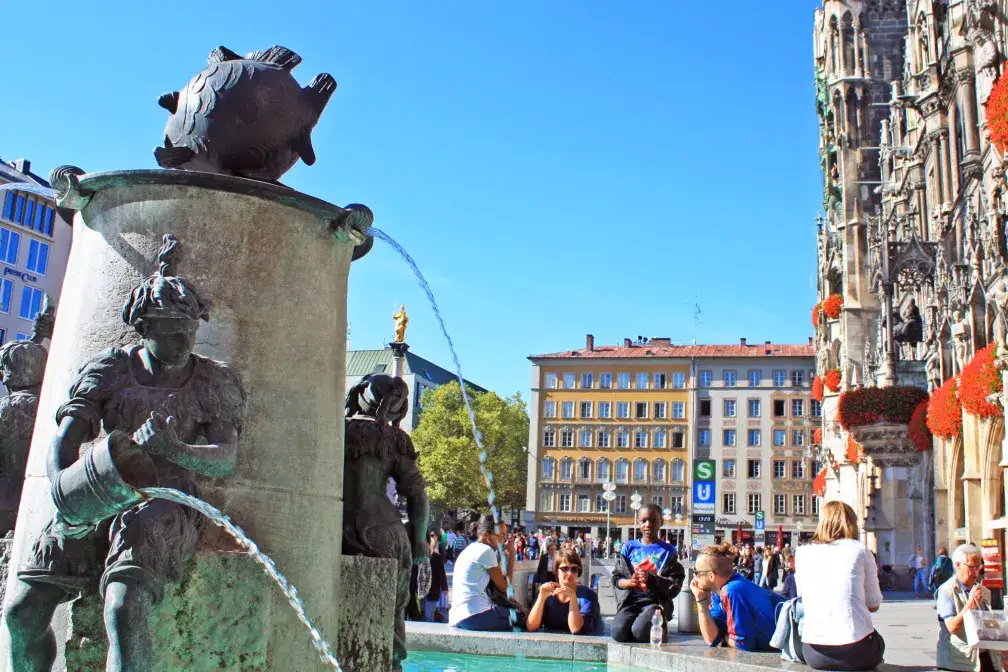
- The Fish Fountain (*Fischbrunnen*) stands directly in front of the New Town Hall and is one of the most popular meeting points on Marienplatz. Its name recalls the time when Marienplatz was Munich's central marketplace and fish, among other goods, were sold there.
- The current fountain dates back to 1954 and was designed by sculptor Josef Henselmann. It incorporates elements from the Neo-Gothic predecessor created by Konrad Knoll, which had been destroyed during the Second World War.
- The Fish Fountain is particularly famous for the "wallet washing" ritual on Ash Wednesday. In this Munich tradition, empty wallets are dipped into the fountain water—a symbolic act intended to ensure they fill up again over the course of the year. The traditional "Butchers' Jump" (*Metzgersprung*) is also associated with the Fish Fountain.
- More about the Fish Fountain
👉 The Fish Fountain stands directly in front of the New Town Hall on Marienplatz and is known as a meeting point, a monument, and the site of the Ash Wednesday wallet-washing ritual.
View of Marienplatz: Town Hall Tower and Alter Peter

You get the best view of Marienplatz from above. Located right on the square, the tower of the New Town Hall offers a view over the Old Town. The ascent is easy, as the tower is accessible by elevator.
A classic vantage point is "Alter Peter" (St. Peter's Church), Munich's oldest parish church. Its tower is just a few steps away from Marienplatz. Those who climb the 306 steps are rewarded with views of Marienplatz, the New Town Hall, the Frauenkirche, and—on a clear day—the Alps.
👉 You get the best view of Marienplatz from the tower of the New Town Hall or from the tower of Alter Peter, right next to the square.
Marienplatz as the start of the pedestrian zone

- Munich’s central pedestrian zone begins at Marienplatz. From here, major shopping streets and promenades wind through the Old Town—such as Kaufingerstraße, Neuhauser Straße, Theatinerstraße, Residenzstraße, and Tal.
- Surrounding the square, you will find shops, cafés, and restaurants, as well as many routes leading to other attractions. Conveniently, the Frauenkirche, Viktualienmarkt, Alter Peter, and Hofbräuhaus are all close by. Marienplatz is therefore an ideal starting point for combining a leisurely stroll through the city with sightseeing.
👉 From Marienplatz, you can reach Kaufingerstraße, Viktualienmarkt, the Frauenkirche, Alter Peter, and Tal on foot in just a few minutes.
Sights near Marienplatz
Many key landmarks in the Old Town are located right at Marienplatz or just a short walk away. The Frauenkirche, Viktualienmarkt, Tal, Kaufingerstraße, Hofbräuhaus, and the Residenz are all within a few minutes' reach. Odeonsplatz is also easily accessible on foot from Marienplatz, making the square a particularly convenient starting point for a first visit to the Old Town.
👉 From Marienplatz, you can reach the Frauenkirche, Viktualienmarkt, Alter Peter, Tal, Kaufingerstraße, the Hofbräuhaus, and the Residenz on foot in just a few minutes.
How to get there: Where exactly is Marienplatz located?

- Marienplatz is located in the heart of the Old Town and is easiest to reach by public transport. The Marienplatz U-Bahn (subway) and S-Bahn (urban rail) station is situated directly beneath the square. It is served by the S-Bahn lines running along the main trunk route (*Stammstrecke*) as well as U-Bahn lines U3 and U6.
- If you are arriving by bicycle, Marienplatz is easily accessible from several directions. However, please be considerate when in the pedestrian zone or during busy periods and walk your bike.
- Arriving by car is not recommended. Marienplatz is located within a pedestrian zone, so there is no direct parking available. If you do drive into the city center, you should use nearby parking garages and walk the final leg of the journey.
- For accessible travel, it is advisable to check the latest information from the MVV or MVG journey planners. These provide details on elevators, escalators, and step-free routes.
👉 The easiest way to get to Marienplatz is by taking the U-Bahn or S-Bahn to the Marienplatz station; arriving by car is not recommended due to the pedestrian zone.
Events on Marienplatz: Christkindlmarkt and more

- Marienplatz is not only a tourist attraction but also one of the city's most important event venues. It is particularly famous for the Munich Christmas Market during the Advent season, when stalls, lights, and a large Christmas tree fill the square in front of the New Town Hall.
- In June, Munich celebrates its City Foundation Festival around Marienplatz; commemorating the city's founding in 1158, the event brings music, entertainment, and information to the Old Town.
- Other established traditions include the "washing of the wallets" at the Fish Fountain on Ash Wednesday. FC Bayern championship celebrations on the Town Hall balcony, Christopher Street Day, and the enthronement of the Carnival Prince and Princess are among the events that frequently turn Marienplatz into a stage.
👉 Some of the best-known events at Marienplatz include the Munich Christmas Market, the City Foundation Festival, the Ash Wednesday wallet-washing ceremony, and championship celebrations on the Town Hall balcony.
History of Marienplatz: The heart of Munich

- Marienplatz is closely linked to Munich's history. An important crossroads existed here as early as the city's founding around 1158; the "Salt Road" intersected with the route connecting the older villages of Schwabing and Sendling. Monks—from whom the city's name, *München*, is derived—settled on the nearby Petersbergl hill.
- For centuries, the square served as the city's central marketplace. Merchants sold goods such as eggs, flour, wine, and fish here—a legacy preserved in the name of the *Fischbrunnen* (Fish Fountain). It was not until 1854, after the market had been relocated, that the square was named Marienplatz; prior to that, it was simply known as the *Markt* (Market), *Platz* (Square), or *Schrannenplatz*.
- Until the era of the "Economic Miracle," Marienplatz was a heavily congested traffic hub. Cars, buses, trams, bicycles, and pedestrians all shared the Old Town's narrow streets. The creation of a pedestrian zone in the late 1960s and early 1970s fundamentally transformed the square. Today, it is a car-free space for strolling, lingering, and meeting up with others.
👉 Until 1854, the square now known as Marienplatz was called Schrannenplatz and served as Munich's central marketplace and meeting point for centuries.
The Marienplatz as birthplace of the Weißwurst
On Carnival Sunday in 1857, so the legend goes, the innkeeper-butcher of the restaurant "Zum Ewigen Licht" in the middle of Marienplatz runs out of sheep intestines for the bratwursts.
He has to resort to pork casings, which are too tough and too big for bratwurst. In a pinch, he fills them with the finished sausage mixture anyway. However, he does not fry the sausages, but scalds them in hot water, because he believes that the wrong casings could burst during frying. This is how the Munich Weißwurst was created, it is said.
Services at Marienplatz: Wi-Fi, webcam, accessibility, and tips
Several convenient services are available for your visit to Marienplatz. You can use the muenchen.de webcam to see what is happening in the square live—either beforehand or while you are on the go. This is especially useful for the Glockenspiel (chimes), events, or the Advent season.
M-WLAN is available at many locations throughout Munich, and Marienplatz is one of the central areas offering free internet access. Taking the U-Bahn (subway) or S-Bahn (urban train) is usually the best way to get to the Old Town.
It is worth arriving a little early when crowds are expected—particularly for the Glockenspiel, Advent weekends, city festivals, and championship celebrations. Great photo opportunities include the Mariensäule (Column of St. Mary) with the New Town Hall, the view towards the Frauenkirche, and the panoramic views from "Alter Peter" (St. Peter's Church) or the Town Hall tower.
If you require accessible routes, you should check the current status of elevators and escalators before your trip. This is especially important if you are traveling with a wheelchair, stroller, or heavy luggage.
👉 Marienplatz offers M-WLAN, a muenchen.de webcam with a live view, and direct U-Bahn and S-Bahn connections via the Marienplatz station.
M-WLAN - Free WiFi in Munich
 The free M-WLAN service is available at numerous locations in Munich, allowing users to surf the Internet free of charge.
M-WLAN is a free service offered by the city together with Stadtwerke München as the technical partner. muenchen.de and M-net act as sponsors.
Frequently Asked Questions about Marienplatz
Where is Marienplatz in Munich located?
Marienplatz is located in the Old Town in the center of Munich. The address is Marienplatz 1, 80331 Munich.
What sights are there at Marienplatz?
Right at Marienplatz, you can see the New Town Hall with its Glockenspiel (carillon), the Old Town Hall, the Mariensäule (Column of St. Mary), and the Fish Fountain. St. Peter's Church ("Alter Peter"), the Frauenkirche, and the Viktualienmarkt are just a short walk away.
When does the Glockenspiel at Marienplatz play?
The Glockenspiel in the New Town Hall plays daily at 11:00 a.m. and 12:00 p.m. From March to October, there is an additional performance at 5:00 p.m., and a night performance takes place at 9:00 p.m.
Is there an admission fee to visit Marienplatz?
No, Marienplatz is a public square and is freely accessible. Admission fees may only apply to specific attractions in the area, such as viewing platforms or guided tours.
How do I get to Marienplatz by public transport?
The easiest way to reach Marienplatz is by taking the U-Bahn (subway) or S-Bahn (urban train) to the Marienplatz station. The station is located directly beneath the square.
Which U-Bahn lines go to Marienplatz?
The U-Bahn lines U3 and S-Bahn lines U6 serve Marienplatz. Additionally, the S-Bahn lines running along the main trunk line (Stammstrecke) stop there.
Can I park at Marienplatz?
Marienplatz is located in a pedestrian zone, so arriving by car is not recommended. Those arriving by car should use nearby parking garages in the Old Town.
What is located near Marienplatz?
Attractions near Marienplatz include the Frauenkirche, Viktualienmarkt, St. Peter's Church ("Alter Peter"), Hofbräuhaus, Kaufingerstraße, Tal, the Residenz, and Odeonsplatz.
When is Marienplatz particularly crowded?
Marienplatz gets particularly crowded during the Glockenspiel performance, on Advent weekends, during the Christmas market, at major city festivals, and during championship celebrations on the Town Hall balcony.
Is there free Wi-Fi at Marienplatz?
Yes, you can use M-WLAN at Marienplatz. This free Wi-Fi service is available at many central locations in Munich.


