
Munich's Highlights – With All the Essential Information
Munich Guide: 25 Top Sights
Munich has more sights than you can see in a weekend trip — and most of them are surprisingly close together. Marienplatz, the Frauenkirche, and the Viktualienmarkt are just a few hundred meters apart in the Old Town, while Nymphenburg Palace, the Olympic Park, and the Allianz Arena await a little further out. This guide takes you to 25 places that define Munich — each with an address, nearest transit stop, admission price, and a tip that will really come in handy once you’re there.

More actions
Quick Overview
- 🏙️ What’s it about? 25 Munich attractions from the Old Town to the city’s neighborhoods, each with an address, transit stop, admission price, and tip
- 🚶 How much time? You can visit the Old Town attractions on foot in a single day; for all 25, you’ll need three days, since Nymphenburg, the Olympic Park, BMW Welt, Hellabrunn, and the Arena are located outside the city center
- 📍 Best starting points: Marienplatz for the Old Town, Odeonsplatz for the Residenz and Ludwigstraße, and the Olympic Center for the Olympic Park and BMW Welt
- 💶 Costs: Squares, parks, markets, church interiors, and BMW Welt are free—towers, palaces, museums, and stadium tours range from 3 to 25 euros
- 👦 Children and teens: Free admission to all state-run museums and palaces for those under 18; the Zoo and the Deutsches Museum have their own family rates
- 🗼 Views from above: Frauenkirche (with elevator), Alter Peter (on foot), City Hall Tower, Bavaria, and the Olympic Hill (free)
- 🚇 Getting There: All destinations are within the MVV inner zone; a day pass is worth it for a day of sightseeing
- 🎟️ Book in Advance: Arena Tour and Nymphenburg Palace tour require a time slot; tickets for the Frauenkirche tower are only available on-site
- ⚠️ Currently under renovation: Olympic Tower (expected to last until early 2027), Neue Pinakothek (expected to last until 2030), the second half of the Deutsches Museum building (expected to last until 2028); Bavaria and the Hall of Fame will be closed from October 20, 2026, through the end of March 2027
The 25 Attractions at a Glance
- ⛪ Frauenkirche – Landmark with a view from the tower
- 🏛️ Marienplatz with the New Town Hall and Glockenspiel – Munich’s city center
- ⚽ Allianz Arena – Stadium with an illuminated facade
- 🏰 Nymphenburg Palace – Baroque palace with park
- ⚙️ Deutsches Museum – Hands-on technology
- 🦏 Hellabrunn Zoo – the world’s first geo-zoo
- 👑 The Residenz with the Court Garden – the Wittelsbach family’s city palace
- 🌳 English Garden – Munich’s green lung
- 🖼️ Art District Kunstareal with the Pinakotheken – 18 museums within a 500-by-500-meter area
- ⛲ Karlsplatz (Stachus) – Gateway to the pedestrian zone
- 🏞️ Isar – Riverbanks for swimming, barbecuing, and biking
- 🥕 Viktualienmarkt – Market and beer garden in the Old Town
- 🛍️ Maximilianstraße with the Maximilianeum – boulevard and state parliament building
- 🏟️ Olympic Park – sports, concerts, and architecture from 1972
- 🔔 Alter Peter – oldest church tower, best view of the Old Town
- 🕯️ St. Michael – Renaissance church with the Wittelsbach crypt
- 🏄 Eisbach Wave – river surfing in the English Garden
- ☕ Odeonsplatz with the Theatinerkirche and Feldherrnhalle – Italian flair
- 🍻 Oktoberfest – September 19 through October 4, 2026
- 🚗 BMW Welt and BMW Museum – architecture and automotive history
- 🗿 Bavaria and the Hall of Fame – a view from the head of a statue
- 🍺 Platzl with the Hofbräuhaus – beer culture and cobblestone streets
- 🏺 Königsplatz – antiquity and classicism
- ✨ Asam Church – Baroque on an eight-meter-high facade
- 🎭 Bavarian State Opera – the national theater on Max-Joseph-Platz
Frauenkirche (Munich Cathedral or Cathedral of Our Lady)

The 15th-century Gothic cathedral and parish church “Our Lady” is the city’s unmistakable landmark. Very few people who walk through the main portal realize that emperors are buried here and that the devil is said to have left his footprint.
The over 500-year-old brick building is the seat of the Archbishop of Munich and Freising. One of the two towers, each nearly 100 meters high, is open to the public: After climbing about 90 steps, an elevator takes you to the glass-enclosed tower room at a height of 80 meters.
- 📍 Frauenplatz 1, 80331 Munich
- 🚇 Marienplatz (U3/U6, S1 through S8)
- 🎟️ Church admission is free; South Tower: 7.50 euros; reduced rate and children ages 7–16: 5.50 euros; free for children 6 and under
- 💡 Tower tickets are available only on-site at the cathedral shop, not online
Marienplatz with the New Town Hall and the carillon

This is where Munich’s heart beats: Marienplatz, with the New Town Hall, is the centre of the state capital – the setting for the Christmas market, for the major sports clubs’ championship celebrations, and for the daily hustle and bustle around the Marian Column.
As the junction between Isartor and Karlstor, and between Sendlinger Tor and Schwabing, the square is the best starting point for any city walk.
- 📍 Marienplatz 8, 80331 Munich
- 🚇 Marienplatz (U3/U6, S1 to S8)
- 🎟️ The square is freely accessible; there is a charge for the tower tour in the New Town Hall
- 💡 The carillon (Glockenspiel) plays at 11 am and 12 noon; from March to October, it also plays at 5 pm – make sure you arrive a good ten minutes early, otherwise you’ll be standing behind the third row
Allianz Arena

The Allianz Arena lies on the northern outskirts of the city like a glowing air cushion: opened in 2005, designed by Herzog & de Meuron, with an outer shell of air cushions that glow in changing colours. The stadium seats around 75,000 people, and on home match days it is almost always full.
Even if you can’t make it to the match, you can still go inside: Arena tours take you to the team changing rooms, the players’ tunnel and the touchline, whilst the FC Bayern Museum displays trophies, shirts and the club’s history dating back to 1900.
- 📍 Werner-Heisenberg-Allee 25, 80939 Munich
- 🚇 Fröttmaning (U6), about a 15-minute walk via the Esplanade
- 🎟️ FC Bayern Museum: 12 euros; Museum with Arena Tour: 25 euros; Museum with Arena View: 19 euros
- 💡 Special rules apply on match days: the guided Arena Tour is cancelled on these days, and museum visits are only possible with a match ticket – check availability in advance and book your tour well in advance
Nymphenburg Palace

A journey back to the era of the Bavarian monarchy: the extensive park grounds with their park castles, the palace canal, the fountains and the Baroque palace. Inside, you’ll find state rooms, the Gallery of Beauties and several museums, including the Marstallmuseum with the Wittelsbach family’s ceremonial carriages.
The park itself is free to enter and is well worth a stroll at any time of year – from spring, when the flowers are in bloom, to winter, when the canal freezes over.
- 📍 Nymphenburg Palace 1, 80638 Munich
- 🚇 Tram 17 to Nymphenburg Palace
- 🎟️ Park free, palace €10, combined ticket €20 in summer, €16 in winter, free for under-18s
Ad

Deutsches Museum

An exhibition centre and a huge play area all in one: on Museum Island, you can turn knobs, flick levers and touch many of the exhibits. Around 20 permanent exhibitions cover topics ranging from nuclear physics and chemistry to musical instruments and health, right through to aerospace and robotics, alongside media stations, laboratories and a flight simulator.
The world’s largest science and technology museum is currently undergoing a major refurbishment: the completed half of the building, housing the new exhibitions, is open, whilst the other half is a building site. As a result, some of the classics from the old exhibition are not on display at the moment – the museum is expected to be fully completed in 2028. What is open, however, easily fills a day: it’s better to choose two or three exhibitions than to rush through everything.
- 📍 Museumsinsel 1, 80538 Munich
- 🚇 S-Bahn to Isartor or tram to Deutsches Museum
- 🎟️ Adults €16, concessions €9, family ticket €33, children under 5 free
- 💡 Before your visit, it’s worth taking a look at the museum’s exhibition guide – and at the daily programme at the entrance, which lists the free demonstrations and experiments
Hellabrunn Zoo (Tierpark Hellabrunn)

A journey around the world on 40 hectares: Founded in 1911, the zoo is regarded as the world’s first ‘geo-zoo’; since 1928, the animals have been organised by continent, some living in natural habitats. Instead of bars, it is often just water ditches that separate visitors from the animals.
The park is situated in the Isarauen landscape conservation area – the walk there through the floodplain forest is almost part of the outing itself.
- 📍 Tierparkstraße 30, 81543 Munich
- 🚇 Thalkirchen (Tierpark) (U3) or bus 52
- 🎟️ Adults 20 euros, children aged 4 to 14 8 euros, concessions 15 euros, small family ticket 25 euros, large family ticket 45 euros
- 💡 Allow at least three hours; the feeding times and keeper meet-ups are listed in the daily schedule at the entrance
Residenz with Court Garden
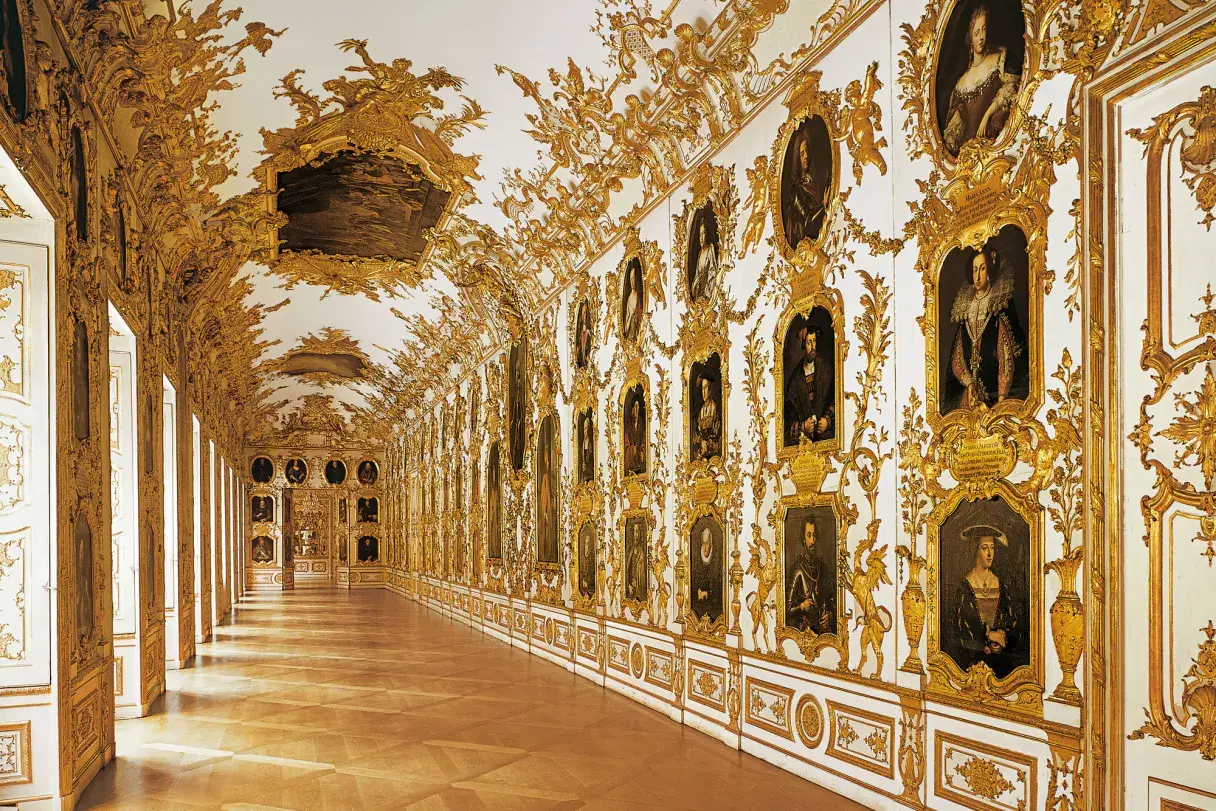
The Munich Residenz is Germany’s largest city-centre palace. Its imposing façade rises up from Max-Joseph-Platz; inside, the tour takes you through apartments, banquet halls and court chapels – over the course of more than 600 years, the building has been continuously extended and remodelled, so the architectural styles vary from room to room.
Also well worth a visit are the Treasury, with its crown jewels and goldsmith’s art, and the adjacent Court Garden (Hofgarten), which is perfect for a leisurely stroll.
- 📍 Residenzstraße 1, 80333 Munich
- 🚇 Odeonsplatz (U3 to U6)
- 🎟️ Court Garden: free; Residenz Museum: 10 euros; Treasury: 10 euros; combined ticket: 15 euros; all-inclusive ticket including the Cuvilliés Theatre: 20 euros; free for under-18s
- 💡 Allow at least three hours for the museum and Treasury together – or choose a specific route
English Garden

Covering 375 hectares, the English Garden is one of the largest inner-city parks in the world – and it is far more than just a lawn: jogging, cycling, volleyball, sunbathing and beer gardens are all to be found in close proximity here.
The park’s architectural features are also well worth seeing: the Monopteros with its view of the Old Town skyline, the Chinese Tower, the Japanese Tea House and the Rumfordschlössl. Throughout the year, events such as the Kocherlball and the Japan Festival take place here.
- 📍 English Garden, 80538 Munich (southern entrance: Prinzregentenstraße)
- 🚇 Lehel (U4/U5), Universität or Giselastraße (U3/U6), Nationalmuseum/Haus der Kunst stop
- 🎟️ Free entry
- 💡 The southern area around the Monopteros and the Chinese Tower is often crowded – it gets much quieter north of Kleinhesseloher See
Art District Kunstareal with the Pinakotheken

Between Königsplatz and Theresienstraße, covering an area of 500 by 500 metres, lies one of Europe’s most concentrated museum districts: 18 museums and exhibition venues, plus over 20 galleries and six universities. The range extends from ancient Egyptian burial artefacts and classical sculptures to contemporary art.
The big names are all within walking distance: the Alte Pinakothek, featuring European painting up to the 18th century; the Pinakothek der Moderne, with four museums under one roof; the Museum Brandhorst, housing works by Warhol and Twombly; the Lenbachhaus, home to the world’s largest collection dedicated to the Blue Rider movement; and the Glyptothek on Königsplatz. The Neue Pinakothek is due to undergo renovation until 2030; in the meantime, its masterpieces – from van Gogh to Spitzweg – are on display in the east wing of the Alte Pinakothek.
- 📍 Maxvorstadt, 80333 Munich; Alte Pinakothek: Barer Str. 27, Pinakothek der Moderne: Barer Str. 40, Lenbachhaus: Luisenstr. 33
- 🚇 Königsplatz or Theresienstraße (U2), tram 27/28 to Pinakotheken, bus 100 (museum route)
- 🎟️ Alte Pinakothek €9, Pinakothek der Moderne €10, Lenbachhaus €10, Glyptothek and Collections of Classical Antiquities combined 6 euros, combined day ticket for four state-run museums 12 euros, free for under-18s
- 💡 On Sundays, admission to the state museums costs just 1 euro – this does not apply to the Lenbachhaus, but admission there is free on the first Thursday of every month from 6 pm to 10 pm
Karlsplatz (Stachus)

The semi-circular Karlsplatz, known to everyone as Stachus, is the western gateway to the pedestrian zone. “It’s as busy as Stachus!” is a saying known throughout Bavaria – and indeed, this is where S-Bahn, U-Bahn and tram lines, cars, buses and pedestrians all converge.
In summer, the Stachus fountain sprays refreshing jets of water; in winter, ice skaters do their laps on an ice rink. Beneath the ground, the Stachus basement forms a small shopping centre in its own right.
- 📍 Karlsplatz, 80335 Munich
- 🚇 Karlsplatz (Stachus) (S1 to S8, U4/U5, several tram lines)
- 🎟️ Free entry
- 💡 It takes about ten minutes to walk from Stachus to Marienplatz through the pedestrian zone – past Karlstor, Bürgersaalkirche and Michaelskirche
Isar river

The Isar is Munich’s open-air swimming pool, sunbathing area and running route all in one: the river flows through the city for almost 14 kilometres, featuring gravel banks, riverside meadows and bridges where half the city gathers in the summer evenings.
Particularly popular are the Isar floodplains at Flaucher and the extensive area around the Reichenbach Bridge. Barbecuing is permitted in certain sections, whilst in others you can swim or go boating during the warmer months.
- 📍 Isar riverbanks within the city limits, popular access points: Flaucher (81371 Munich) and Reichenbach Bridge (80469 Munich)
- 🚇 Thalkirchen (U3) for Flaucher, Fraunhoferstraße (U1/U2) for the Reichenbach Bridge
- 🎟️ Free entry
- 💡 The current is stronger than it looks: swim only in designated areas, not near weirs
Viktualienmarkt

Munich’s largest market offers fresh, often regional produce – fruit, cheese, fish, flowers and spices – across 22,000 square metres. It has been part of the cityscape for over 200 years and has long since become a landmark in its own right.
At lunchtime, the market becomes the Old Town’s canteen: in the beer garden beneath the chestnut trees, craftspeople sit alongside visitors from all over the world.
- 📍 Viktualienmarkt 6, 80331 Munich
- 🚇 Marienplatz (U3/U6, S1 to S8), a two-minute walk
- 🎟️ Free entry; the stalls are open Monday to Saturday
- 💡 You’re allowed to bring your own food to the beer garden, but you must buy your drinks there
Maximilianstraße with Maximilianeum

From 1852 onwards, King Maximilian II had his own grand boulevard built – and devised his own architectural style to go with it: the Maximilian style. Maximilianstraße runs from Max-Joseph-Platz towards the Isar, past the Museum of Ethnology, the Max Monument and the city’s most expensive shop windows.
It ends on the high bank of the Isar at the Maximilianeum, built in 1874, which has been the seat of the Bavarian State Parliament since 1949 and is home to a scholarship foundation. The wall in front of it is one of Munich’s most popular spots for unwinding after work, offering views across the city.
- 📍 Maximilianstraße, 80539 Munich; Maximilianeum: Max-Planck-Str. 1, 81675 Munich
- 🚇 Tram 19 runs along the street to the Maximilianeum; U4/U5 Max-Weber-Platz
- 🎟️ The street and Isar terrace are free to access; a tour of the interior of the State Parliament is free, but requires prior booking
- 💡 Individual visitors can enter the building during committee and plenary sessions or on evening guided tours – for a look at the historic rooms, it’s worth checking the State Parliament’s calendar of events
Olympiapark (Olympic Park)

Created for the 1972 Olympic Games, the Olympic Park brings together some of the city’s most important buildings in a compact area: the Olympic Stadium with its tent-like roof, the Olympic Hall and the 291-metre-high Olympic Tower, Munich’s tallest building.
Spanning 850,000 square metres, the park also hosts concerts, festivals and sporting events, and features the Olympiaberg, one of Munich’s most popular spots for watching the sunset.
- 📍 Spiridon-Louis-Ring 21, 80809 Munich
- 🚇 Olympiazentrum (U3)
- 🎟️ Free parking; stadium and roof tours subject to a fee
- 💡 The Olympic Tower is currently undergoing renovation and is not expected to reopen until the first quarter of 2027 – for the view, the free climb up the Olympic Hill is well worth it instead
Alter Peter

St Peter’s, behind Marienplatz, is Munich’s oldest parish church. Its tower, known to everyone as ‘Alter Peter’, is one of the city’s best vantage points and houses Munich’s oldest bells and its first tower clocks – eight dials, a number that even Karl Valentin used to joke about.
The interior is also well worth a look: the Baroque high altar with its golden statue of St Peter and the relics of St Munditia, laid out in a glass coffin.
- 📍 Rindermarkt 1, 80331 Munich
- 🚇 Marienplatz (U3/U6, S1 to S8)
- 🎟️ Free entry to the church; climb up the tower: 5 euros, concessions 3 euros, schoolchildren aged 6 to 18 2 euros, under 6s free
- 💡 Around 300 steps, no lift, and the staircase is so narrow that traffic comes to a standstill when people are coming and going – it’s least crowded in the mornings
St Michael's

Nestled amongst the department stores in the pedestrianised area stands the Jesuit Church of St Michael, completed in 1597 and one of the most significant Renaissance buildings north of the Alps. Its barrel vault spans 20 metres – for a long time, it was considered the largest self-supporting vault of its kind after St Peter’s Basilica in Rome.
Beneath the chancel lies the Wittelsbach crypt: around 30 members of the House of Wittelsbach rest in metal sarcophagi, including the church’s patron, Wilhelm V, Elector Maximilian I and, the most famous of them all, King Ludwig II. His coffin is usually covered with flowers left there by visitors.
- 📍 Neuhauser Str. 6, 80333 Munich
- 🚇 Marienplatz or Karlsplatz (Stachus), a five-minute walk from either
- 🎟️ Church: free; Wittelsbach Crypt: €3, concessions €2, young people aged 11 to 17 €1, children under 10 free
- 💡 The combined ticket for €5 also includes access to the Wittelsbach tombs in the crypt of the Theatinerkirche on Odeonsplatz; the crypt is closed on Sundays
Eisbach Wave

Surfing right in the city centre: at the southern end of the English Garden, right next to the Haus der Kunst, the Eisbach cascades over a step, forming a standing wave. When you arrive there, you’ll usually see a line of surfers waiting on the bank for their turn – in swimming trunks in summer, and in wetsuits with hoods in winter.
The spectacle goes on all year round and costs nothing. The best spot is on the small bridge directly above the wave: from there, you can look almost straight down onto the surfers’ boards. Bathing and swimming are not permitted here.
- 📍 Prinzregentenstraße 1, 80538 Munich (at the Haus der Kunst)
- 🚇 Lehel (U4/U5) or the Nationalmuseum/Haus der Kunst stop
- 🎟️ Free to watch
- 💡 The light is at its best in the late afternoon, when the sun shines onto the wave from Prinzregentenstraße – a great time for photos, as the bridge isn’t backlit then
Odeonsplatz, with the Theatinerkirche and the Feldherrnhalle

“La dolce vita” is truly on display at Odeonsplatz in Munich: The Italian-style square is complete with a Late Baroque-style church, a building designed in the style of the Loggia dei Lanzi in Florence and a great deal of hustle and bustle. It also serves as the northern boundary of the pedestrian zone and forms the starting point of Ludwigstrasse.
A number of landmarks are located within a stone’s throw of Odeonsplatz, including the Residenz palace with the Hofgarten (Royal Garden), the Feldherrnhalle (Field Marshalls’ Hall), the Theatinerkirche (Theatine Church), several palaces and the sweeping Bazargebäude (Bazaar Building). High-profile events are regularly held in the square, including the Stadtgründungsfest celebrating the city’s founding, the Streetlife Festival and the popular Klassik am Odeonsplatz open-air classical music festival.
- 📍 Odeonsplatz, 80539 Munich
- 🚇 Odeonsplatz (U3 to U6)
- 🎟️ The square and church are freely accessible
- 💡 The crypt of the Theatinerkirche, containing the Wittelsbach tombs, is open at fixed times and is often overlooked by most visitors
Oktoberfest

Munich Oktoberfest, called the "Wiesn" (meadow) by locals, is the world’s largest folk festival. First held in 1810 to celebrate the marriage of King Ludwig I and Princess Therese of Saxe-Hildburghausen, the festival has now become one of the top highlights of the Munich calendar.
Around six million guests from all over the world flock to Munich every year to attend the two-week festival on the Theresienwiese. Opened on the 200th anniversary of Oktoberfest in 2010, the Oide Wiesn (Old Wiesn) is celebrated on a separate, adjacent site – the perfect place to experience a traditional Oktoberfest as it was once,
- 📍 Theresienwiese, 80339 Munich
- 🚇 Theresienwiese (U4/U5), Goetheplatz or Poccistraße (U3/U6), Hackerbrücke S-Bahn station
- 🎟️ Free entry to the grounds and the tents; a small entry fee (4 euros) applies for the Oide Wiesn
- 💡 Family Days are the two Tuesdays, 22 and 29 September 2026, with reduced prices until 7 pm
BMW Welt and the BMW Museum

On the northern edge of the Olympic Park, three buildings from two different eras stand close together: the ‘Vierzylinder’ from 1972, designed by Karl Schwanzer and now a listed building; the neighbouring museum; and, opposite, the BMW Welt from 2007 – a twisted double cone of glass and steel, whose roof appears to float freely above the hall.
The museum showcases the history of technology and design from 1916 onwards, ranging from aircraft engines and motorbikes to motor racing. The exhibition hall next door is open to the public free of charge, whilst the ‘Vierzylinder’ can only be viewed from the outside.
- 📍 BMW Welt: Am Olympiapark 1, BMW Museum: Am Olympiapark 2, 80809 Munich
- 🚇 Olympiazentrum (U3)
- 🎟️ BMW Welt free, BMW Museum 10 euros
- 💡 The route from the Olympic Park to BMW Welt takes you over a bridge past the Olympic Lake – the two entrances are less than a ten-minute walk apart
Bavaria and the Hall of Fame
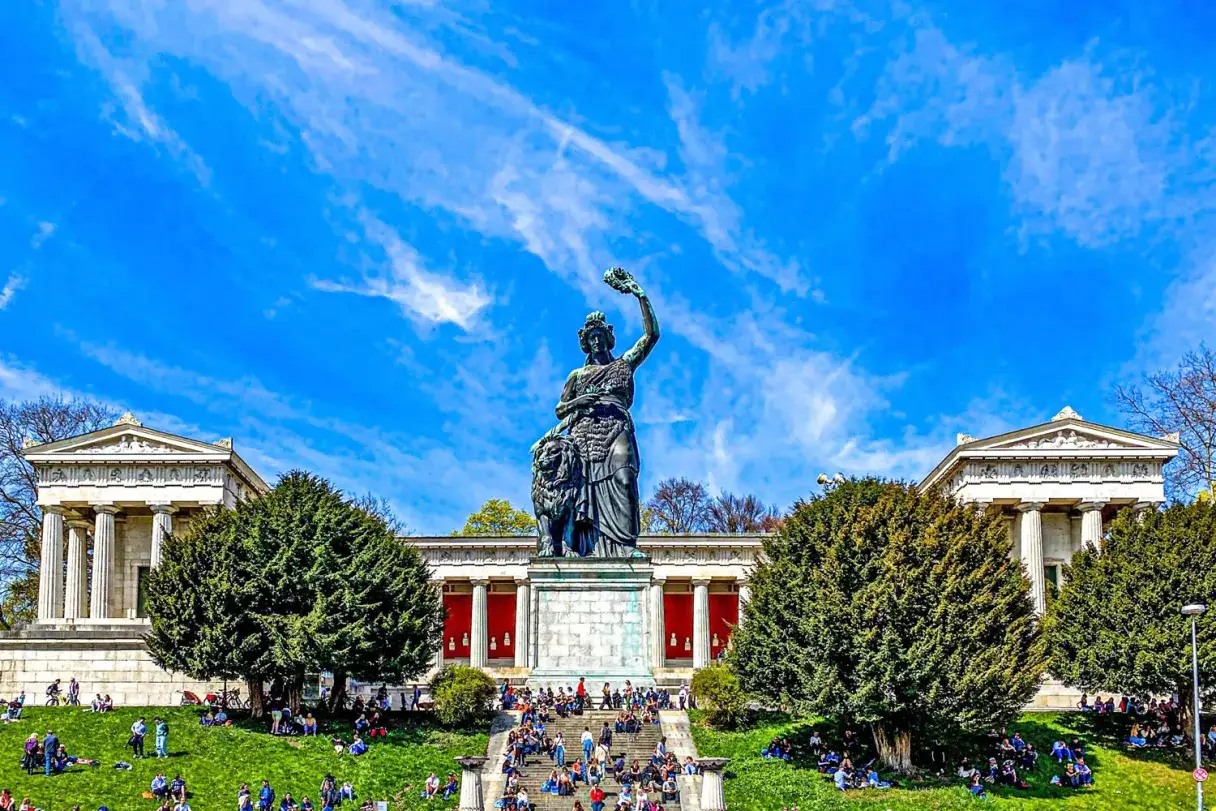
The 18-metre-high bronze statue has towered over the Theresienwiese since 1850 and is a symbol of the Free State. It was designed by Ludwig Schwanthaler on behalf of King Ludwig I and cast by Ferdinand von Miller – a technical masterpiece in its day. At its side stands a Bavarian lion.
The highlight is the climb inside: a narrow spiral staircase leads up into the head, where peepholes offer views across the festival grounds and the skyline. Behind it, the Hall of Fame, with its busts of notable figures, completes the ensemble.
- 📍 Theresienhöhe 16, 80339 Munich
- 🚇 Theresienwiese or Schwanthalerhöhe (U4/U5)
- 🎟️ Hall of Fame and Bavaria: 5 euros, concessions 4 euros, free for under-18s
- 💡 Winter closure: Bavaria and the Hall of Fame will be closed from 20 October 2026 until the end of March 2027
Platzl in the old town with the Hofbräuhaus

At the Platzl in the Old Town, you can get a sense of what Munich once looked like: town houses, cobbled streets, narrow alleys. The world-famous Hofbräuhaus has stood here since 1608; its Neo-Renaissance building is a real eye-catcher even from the outside.
All around are traditional pubs, the Platzl Theatre and some of the city’s oldest establishments – a fitting end to a tour of the Old Town.
- 📍 Platzl 9, 80331 Munich
- 🚇 Marienplatz (U3/U6, S1 to S8) or Isartor (S-Bahn), both a five-minute walk away
- 🎟️ Free entry
- 💡 The square gets busy in the evening – if you want to photograph the architecture, come early in the morning
Königsplatz

Königsplatz combines architecture from ancient Greece with European classicism. It is surrounded by three very different museums – the Glyptothek, the State Collections of Antiquities and the Lenbachhaus – showcasing everything from ancient sculptures to the Blue Rider movement.
In summer, the square becomes a venue for open-air concerts and festivals. A memorial commemorates the Nazis’ use of Königsplatz for party rallies and book burnings. The surrounding museums form part of the Kunstareal.
- 📍 Königsplatz, 80333 Munich
- 🚇 Königsplatz (U2)
- 🎟️ Free admission; a combined day ticket for the Glyptothek and the Collections of Classical Antiquities costs 6 euros, concessions 4 euros; on Sundays, 1 euro per museum; free for under-18s
- 💡 The square is the natural starting point for a day in the Kunstareal – from here, it’s less than ten minutes’ walk to the Museum Brandhorst
Asam Church

Almost easy to miss from the outside, yet almost beyond comprehension on the inside: the Asam Church on Sendlinger Straße is just eight metres wide, but 22 metres deep – and decorated down to the last centimetre. The brothers Cosmas Damian and Egid Quirin Asam built it between 1733 and 1746 as a private church next to their home and were therefore free to design it as they wished.
The result is regarded as one of the most important works of the South German late Baroque period: the space becomes lighter from bottom to top, from the dark ground floor up to the bright ceiling fresco. Officially, the church is called St Johann Nepomuk, though this name is never used.
- 📍 Sendlinger Str. 32, 80331 Munich
- 🚇 Sendlinger Tor (U1 to U3, U6) or Marienplatz, both a few minutes’ walk away
- 🎟️ Free entry
- 💡 In the morning, light streams through the east window directly into the interior – the best time to visit; furthermore, the church cannot be visited during services
Bavarian State Opera

The Bavarian State Opera looks back on some 350 years of history and is one of the largest opera companies in the world. It all began in the 17th century with a theatre in the Residenz, where Elector Ferdinand Maria had the first Italian operas performed.
Today, the company performs at the National Theatre on Max-Joseph-Platz, which opened in 1818. Around 450 performances per season attract more than half a million visitors, with the Munich Opera Festival in the summer being the highlight.
- 📍 Max-Joseph-Platz 2, 80539 Munich
- 🚇 Odeonsplatz or Marienplatz, tram 19 to Nationaltheater
- 🎟️ Prices vary greatly depending on the performance and seat category; standing room is the cheapest option
- 💡 During the free public viewing event ‘Opera for All’ in the summer, a performance is broadcast live onto Max-Joseph-Platz
Munich’s sights by interest
Not everyone wants to see the same things. These lists group the 25 destinations according to what you’re planning to do.
The best views
Frauenkirche (south tower, 80 metres, with lift), Alter Peter (56 metres, around 300 steps), the Town Hall tower on Marienplatz, the head of the Bavaria statue and the Isarterrasse in front of the Maximilianeum. Free and accessible by lift without any climbing: the Olympiaberg. The Olympic Tower is expected to remain closed until 2027.
Free attractions in Munich
Marienplatz, Viktualienmarkt, the English Garden, the River Isar, Platzl, Odeonsplatz, Königsplatz, Karlsplatz, Maximilianstraße, the grounds of Nymphenburg Palace, the Olympic Park and the Eisbach Wave are all free to visit. Added to these are the interiors of the Frauenkirche, St Peter’s, St Michael’s and the Asam Church – and BMW Welt, which is the city’s only major exhibition centre that is free of charge.
With children
Hellabrunn Zoo and the Deutsches Museum each take up half a day to a full day. Then there’s the Olympic Park and the Isar riverbanks for a stroll, BMW Welt for hands-on experiences, the Glockenspiel for a short show, and the Eisbach Wave, because surfing in the park is simply unforgettable. Football fans should add the Arena Tour to their itinerary.
When it rains
The Kunstareal, comprising the Alte Pinakothek, the Pinakothek der Moderne, the Museum Brandhorst and the Lenbachhaus, brings together the greatest number of indoor attractions within a very short distance; added to these are the Deutsches Museum, the Residenz with its Treasury, and the BMW Museum. The interiors of the Asam Church and St Michael’s are also destinations in their own right in bad weather – and the glass-enclosed tower room of the Frauenkirche is accessible even in drizzling rain.
Architecture and Modernism
For those who want to see more than just Baroque: the tent-like roof of the 1972 Olympic Stadium, the BMW Four-Cylinder building next to it, the BMW Welt from 2007 and the air-cushion shell of the Allianz Arena. All four buildings are located in the north of Munich, three of them within walking distance of one another.
Munich on foot in a day
Karlsplatz, St Michael’s, the Frauenkirche, Marienplatz with its glockenspiel, Alter Peter, the Viktualienmarkt, the Asam Church, Platzl, Odeonsplatz with the Residenz and the Hofgarten, continuing along Maximilianstraße: this route makes for a walk of around five kilometres, without having to change transport once.
Getting around in Munich
- 🚇 MVV: Almost all destinations are within Zone M. A day ticket is worth it for a day of sightseeing; for groups, the group day ticket is recommended
- 🎟️ Combined tickets: Day and annual tickets are available for the state museums; for the palaces and Bavaria, the Bavarian Palace Administration offers a multi-day ticket
- ℹ️ Tourist Information: at the Town Hall on Marienplatz; tickets for the tower climb at the New Town Hall are also available there
- ♿ Accessibility: Museums, the Residenz and Nymphenburg Palace are largely accessible; the towers of the Alter Peter and Bavaria are not
- 🚲 Getting around: Within the Old Town, you’ll get around faster on foot than by any form of transport
Frequently asked questions about Munich’s sights
Which sight should you visit first in Munich?
Marienplatz. It’s the heart of Munich, within walking distance of the Frauenkirche, Alter Peter, Viktualienmarkt and Platzl, and can be reached from anywhere by underground and S-Bahn.
How many days do you need to see the top attractions?
One day is enough for the Old Town highlights. For all 25, you should allow three days, as Nymphenburg, the Olympic Park, BMW Welt, Hellabrunn and the Allianz Arena are located outside the city centre.
Which attractions in Munich are free?
All squares, parks and the Viktualienmarkt: Marienplatz, Odeonsplatz, Königsplatz, Karlsplatz, the English Garden, the Isar riverbanks, the Olympic Park and Nymphenburg Palace Park. Watching the Eisbach wave and visiting the interiors of the churches are also free.
What is currently closed in Munich?
The Olympic Tower is closed for renovation and is expected to reopen in the first quarter of 2027. The Neue Pinakothek is expected to remain closed until 2030 due to a major refurbishment; its key works can be viewed at the Alte Pinakothek and the Schack Collection. Bavaria and the Hall of Fame will be closed for the winter break from 20 October 2026 until the end of March 2027.
Where can you get the best view over Munich?
From the south tower of the Frauenkirche at a height of 80 metres, with a lift and a glass-enclosed platform. A more strenuous option is the Alter Peter with around 300 steps; the Olympiaberg in the Olympiapark is free of charge.
Can you surf on the Eisbach wave?
Yes, surfing on the Eisbach wave is permitted. The spot is considered challenging and is reserved for experienced river surfers; the current rules are displayed on signs at the site.
What is the Kunstareal in Munich?
The Kunstareal is Munich’s museum quarter in Maxvorstadt, between Königsplatz and Theresienstraße. Covering an area of 500 by 500 metres, it is home to 18 museums and exhibition venues, including the three Pinakotheken, the Museum Brandhorst, the Lenbachhaus with its ‘Blauer Reiter’ collection, the Glyptothek and the Nazi Documentation Centre.
When is the Oktoberfest in 2026?
From 19 September to 4 October 2026 at the Theresienwiese. Entry to the grounds and the tents is free; the first beer is tapped at 12 noon on the first Saturday.
Do children pay admission to Munich’s museums?
Children and young people up to the age of 18 enjoy free entry to state-run museums and palaces. At the Deutsches Museum, children under 5 go in for free; older children pay the reduced rate.
Is entry to BMW Welt free?
Yes, there is no admission charge for BMW Welt and no booking is required. You only pay 10 euros per person for the neighbouring BMW Museum.
Can you visit the Allianz Arena on a non-match day?
Yes, on non-match days, arena tours are available through the changing rooms, the players’ tunnel and the interior of the stadium; admission to the FC Bayern Museum costs 12 euros. On home match days, the guided tour is not available, and the museum is only accessible with a match ticket.
Where is King Ludwig II buried?
In the Wittelsbach crypt at the Jesuit Church of St Michael on Neuhauser Straße. The entrance is at the front right of the church and costs 3 euros.


